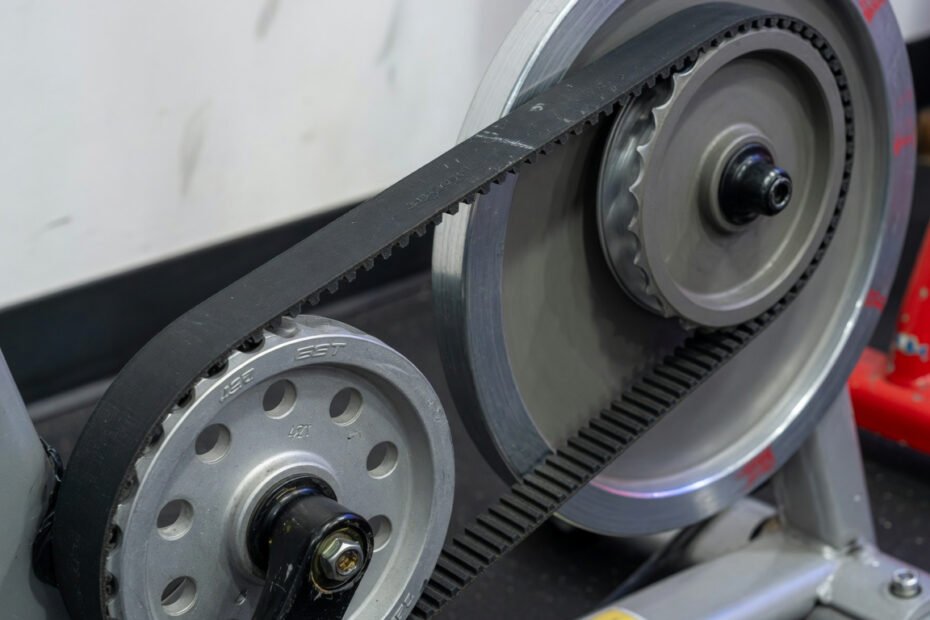
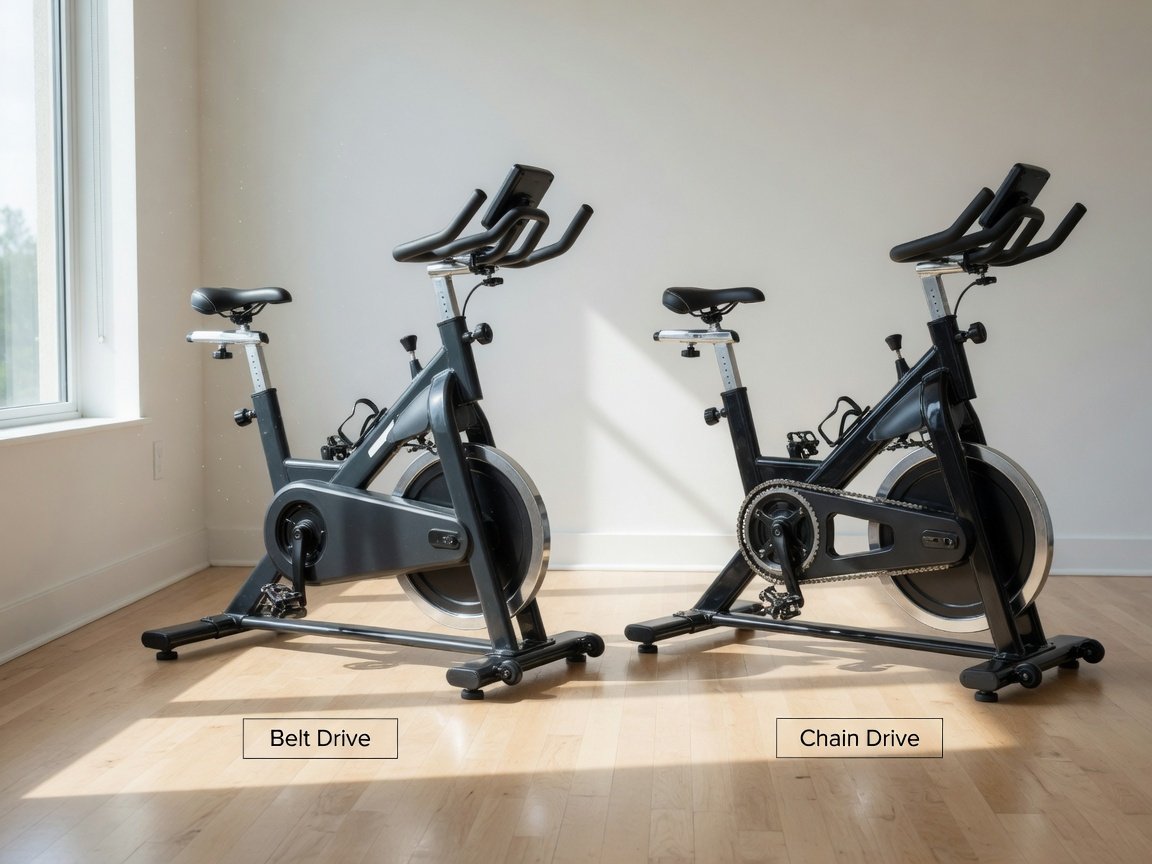
The difference between a belt drive and chain drive spin bike comes down to three things: noise, maintenance, and ride feel. Belt drive bikes use a smooth rubber or polyurethane belt — they run near-silently and need almost zero upkeep. Chain drive bikes use a metal chain — they are louder and need periodic lubrication, but they deliver a raw, authentic cycling sensation that serious riders often prefer.
Some of the links in this article may be affiliate links. If you make a purchase through these links, we may earn a small commission at no extra cost to you. Thank you.
Key Takeaways
- Belt drive spin bikes are near-silent, require almost no maintenance, and are ideal for home or apartment use.
- Chain drive spin bikes are louder, need periodic lubrication, and replicate the feel of riding a real road bike.
- Belt drives typically cost 15–30% more upfront but save money on parts and servicing over time.
- Neither is universally better — your environment, budget, and training goals determine which is right for you.
What Exactly Is a Belt Drive Spin Bike?
A belt drive spin bike uses a continuous loop of reinforced rubber or polyurethane instead of a metal chain to transfer power from your pedals to the flywheel. The belt wraps around two pulleys — one at the crank and one at the flywheel — and moves energy smoothly and quietly with every revolution.

Belt drive technology originally came from the automotive and industrial machinery world. Manufacturers adapted it for indoor cycling in the mid-2000s as demand grew for quieter home fitness equipment. Today, belt drives appear on the majority of premium home spin bikes, including studio-style models built specifically for apartment use.
The biggest practical advantage is noise. Industry estimates place belt drive bikes at roughly 50–60 decibels during use — about the volume of a normal conversation. A chain drive bike at similar intensity typically registers at 65–75 decibels. That gap sounds small on paper, but it is enormous when someone is sleeping in the next room.
Belt drives also wear slowly and require no lubrication at all. A quality belt can last 10,000 to 15,000 miles of riding before it needs replacement, according to fitness equipment service data. For most home cyclists, that translates to years — sometimes a decade — of maintenance-free riding.
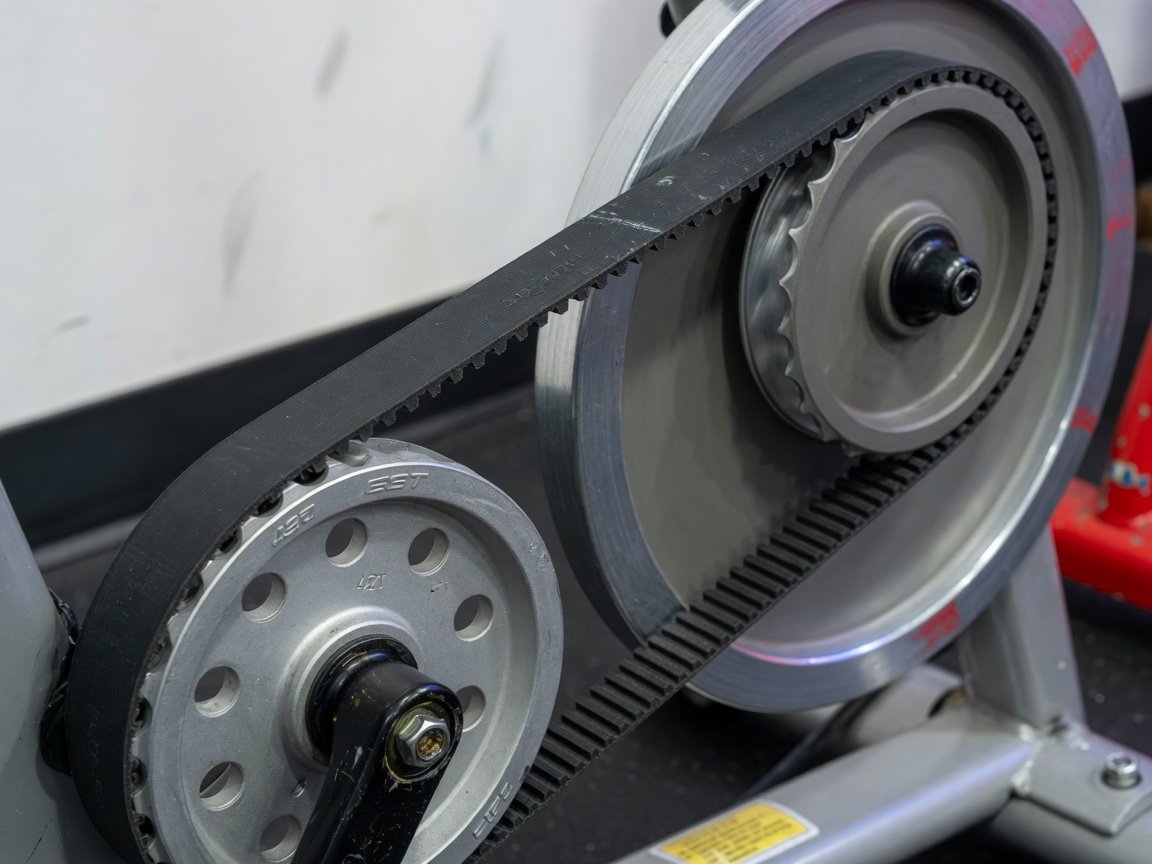
What Is a Chain Drive Spin Bike?
A chain drive spin bike works exactly like a regular bicycle. A metal chain connects the crank to the flywheel sprocket, transferring pedal power with every revolution. The mechanics are identical to a road bike, which is precisely why chain drive models are popular among competitive cyclists and triathletes who train indoors during winter months or bad weather.
Chain drives have been standard on spin bikes since indoor cycling became popular in the 1980s and 1990s. Early commercial bikes — including the iconic Schwinn Spinner — all ran chain drive systems. The technology is proven, simple, and straightforward to service with basic tools.
The trade-off is noise and ongoing upkeep. A metal chain produces a distinct clicking or whirring sound that increases as the chain wears or dries out. Most manufacturers recommend lubricating the chain every 100 to 200 hours of use and replacing it every 2,000 to 3,000 hours. That is manageable for most riders but does add a genuine maintenance commitment that belt drive owners never face.
On the cost side, chain drives are generally cheaper to manufacture. That saving typically passes directly to the consumer, making chain drive spin bikes the more affordable option at entry and mid-level price points across the market.
How Different Is the Noise Level Between Belt and Chain Spin Bikes?
Noise is the single most noticeable difference between these two drive systems in everyday use — and it matters far more than most buyers expect before they actually experience it firsthand.
A belt drive bike at full sprint sounds roughly like a box fan running on medium speed. You hear your breathing, your music, and your own heartbeat far more than the bike itself. A chain drive bike at the same intensity sounds more like a bicycle rolling down a road — a rhythmic mechanical clicking combined with a steady flywheel whir.
In practice, belt drive bikes are the clear choice in these situations:
- Apartments with thin walls or shared floors
- Early morning or late-night workouts when others are sleeping
- Home offices where you ride during calls or video meetings
- Shared living spaces where noise regularly causes friction
Chain drive bikes are perfectly acceptable noise-wise in these scenarios:
- Detached homes with a dedicated gym room or basement setup
- Commercial fitness studios where ambient music drowns out mechanical sound
- Garages or outbuildings where sound transmission is not an issue
- Training environments where the mechanical sound is actually preferred
One important point worth making: a well-maintained, freshly lubricated chain is noticeably quieter than a dry or worn one. A large portion of chain drive noise complaints stem from neglected maintenance rather than the drive system itself. Regular lubrication keeps chain bikes significantly quieter than the worst-case descriptions suggest.
Which Drive System Requires Less Maintenance?
Belt drive bikes win the maintenance comparison decisively. For most home riders, there is almost nothing to do. The belt does not need lubrication, does not stretch the way a metal chain does, and leaves no grease marks on your floor, clothing, or hands. A once-yearly tension check and the occasional wipe-down covers it completely.
Chain drive bikes require more active care. Here is a realistic maintenance schedule for a chain drive spin bike used five days per week:
- Every two weeks: Wipe down the chain with a dry cloth to remove dust and sweat residue.
- Every 100 hours of use: Apply a light bicycle chain lubricant along the full chain length.
- Every 500 hours: Inspect the chain for stretch using a chain wear indicator tool.
- Every 2,000–3,000 hours: Replace the chain and inspect the sprocket teeth for wear.
- Annually: Check the crank bearings and bottom bracket for smooth, play-free rotation.
For a rider training five days a week at 45 minutes per session, 100 hours of use arrives in roughly 26 weeks. That means lubrication is a twice-yearly task — manageable but real. Over a five-year ownership period, maintenance costs on a chain drive bike typically exceed those of a belt drive when you account for lubricant, chain replacements, and occasional professional servicing. A replacement bicycle chain runs $15–$40. A replacement belt, when it eventually wears out, runs $40–$80 but lasts far longer.
Does the Pedalling Feel Different on Belt vs Chain Spin Bikes?
Yes — and this is where personal preference becomes the deciding factor. The two drive systems deliver a noticeably different pedalling sensation, even at similar resistance levels.
Belt drive bikes feel smooth and consistent through the entire pedal stroke. There is minimal mechanical resistance from the drivetrain itself, and the transition between your power phase and recovery phase is seamless. Many riders describe it as gliding, particularly at lower cadence ranges where the absence of mechanical feedback is most apparent.
Chain drive bikes feel more mechanical and reactive. You can sense the chain engaging and releasing with each pedal revolution. For competitive cyclists, this is not unpleasant — it is the exact sensation of riding a real road bike. The feedback feels authentic and gives riders a rhythm reference that some find easier to sustain at high cadences.
Some riders actually find belt drives too smooth. At sprint cadences of 100 RPM and above, the absence of mechanical pull can make it harder to find a rhythm. However, at moderate to high resistance levels, most riders cannot identify any meaningful difference between the two systems.
From a training outcome perspective, cycling coaches consistently note that neither feel is superior for cardiovascular or muscular conditioning. Both systems deliver an equally effective workout. The difference is psychological preference and training specificity — not objective performance.
How Do Belt and Chain Spin Bikes Compare on Cost?
Price is one of the clearest practical differences between the two options. Belt drive technology adds manufacturing complexity, which pushes the price of belt drive bikes higher than equivalent chain drive models at most market segments.
Here is a general market breakdown across price tiers in 2026:
| Price Range | Belt Drive Availability | Chain Drive Availability |
|---|---|---|
| Under $300 | Very limited — mostly budget models with lower quality belts | Wide selection of entry-level options |
| $300–$600 | Several solid mid-range choices | Strong selection with good build quality |
| $600–$1,200 | Most popular belt drive segment — best overall value | Fewer options; premium commercial-grade builds |
| $1,200+ | Premium studio-grade bikes dominate | Heavy-duty commercial chain drive bikes |
The total cost of ownership picture shifts significantly over time. Belt drive bikes save approximately $50–$150 per year in lubrication, chain replacement, and servicing costs. Over five years, a belt drive bike that costs $200 more upfront can easily break even or come out ahead on total spend — depending on how frequently you ride and whether you service the chain yourself or pay a technician.
Commercial gyms often continue choosing chain drive bikes for high-use environments because individual chain replacements are cheap and fast. Studios running bikes for 8–12 hours per day find that belt replacement — though infrequent — requires a longer downtime event when it does occur. For residential use, that calculation reverses entirely.
Which Is Better for Home Use?
For the vast majority of home riders, belt drive is the stronger choice. The reasoning is straightforward.
Most people buying a spin bike for home use are not elite cyclists. They want a reliable, enjoyable workout without dealing with mechanical issues. Belt drives deliver exactly that. You buy the bike, you ride the bike, and you forget the drivetrain exists for years at a time.
The noise advantage is particularly powerful at home. A 2024 survey of home gym equipment buyers found noise level ranked as the second most important purchasing consideration after price — ahead of features, brand recognition, and aesthetics. Belt drive bikes address that concern completely, removing it from the equation.
Home riders also benefit from the cleaner operation. Belt drives produce no grease, no oil residue, and no lubricant smell. That matters considerably when your spin bike sits in a living room, bedroom, or shared domestic space rather than a dedicated facility with concrete floors and floor drains.
The exception worth noting is the serious cyclist or triathlete who trains indoors as a direct complement to outdoor riding. If you ride a road bike regularly and want your indoor sessions to mirror outdoor mechanics as closely as possible, a chain drive spin bike delivers a more authentic pedalling sensation that belt drives simply cannot replicate.
Which Is Better for Studio or Commercial Gym Use?
Commercial fitness environments present a different set of priorities. Noise is rarely the deciding factor in a studio with loud music. Maintenance efficiency, part availability, and long-term durability under heavy use dominate the decision instead.
Commercial gyms have historically favoured chain drive bikes for several practical reasons:
- Chain replacement is fast — typically 15 minutes with basic hand tools.
- Replacement chains are inexpensive and available from any bike shop or online retailer.
- Any qualified gym technician can service a chain drive without manufacturer-specific training.
- Chain drive bikes are more affordable to purchase when equipping a full studio floor.
However, the commercial market is shifting noticeably. Premium boutique cycling studios — facilities charging $25–$40 per class — increasingly install belt drive bikes as an explicit quality signal to customers. The quieter, smoother ride aligns with the premium experience they are selling and differentiates them from basic gym offerings.
For standard gyms running group cycling classes on tight equipment budgets, a robust chain drive commercial bike remains a practical, cost-effective choice. For boutique studios competing on experience quality, belt drive bikes can justify the higher per-unit cost through customer perception, reduced in-class noise, and lower long-term servicing frequency.
What Are the Full Pros and Cons of Each Drive System?
Here is a direct side-by-side summary to make your decision straightforward.
Belt Drive Spin Bike — Pros and Cons
- ✅ Near-silent operation during all workout intensities
- ✅ Zero lubrication required throughout ownership
- ✅ Smooth, consistent pedalling feel at all resistance levels
- ✅ No grease, oil residue, or lubricant smell
- ✅ Very low long-term maintenance cost and time investment
- ✅ Ideal for apartments, shared spaces, and early morning use
- ❌ Higher upfront purchase price across all market tiers
- ❌ Belt replacement requires sourcing model-specific parts
- ❌ Slightly less mechanical feedback for cycling purists at high cadence
Chain Drive Spin Bike — Pros and Cons
- ✅ Authentic road-bike pedalling feel and mechanical feedback
- ✅ Lower upfront purchase price at entry and mid-range levels
- ✅ Replacement parts widely available and inexpensive
- ✅ Fast and easy to service in commercial environments
- ✅ Proven technology with a 40-year track record in fitness
- ❌ Noticeably louder than belt drive at all intensity levels
- ❌ Requires periodic lubrication every 100–200 hours of use
- ❌ Chain produces grease and residue on floors and hands
- ❌ Higher cumulative maintenance time and cost over years of ownership
What Do Fitness Experts Say About Belt vs Chain Spin Bikes?
Fitness professionals broadly agree that both systems deliver equally effective cardiovascular and muscular conditioning. The expert debate centres on user experience and training specificity — not on fitness outcomes.
“For home users who want to ride without disturbing anyone, belt drive is almost always the right recommendation,” says a certified indoor cycling instructor with over a decade of experience coaching at boutique studios and large commercial gyms. “The silence genuinely changes how people use the bike — they ride it more consistently because it feels less disruptive to the household.”
Performance coaches working with competitive cyclists and triathletes tend to come down on the side of chain drives for specificity training. When athletes need indoor sessions to replicate the exact biomechanics of outdoor riding, the chain’s mechanical engagement most closely mirrors real-world road feel.
“The feel difference is subtle but real and cumulative,” notes a cycling coach who works with masters-level triathletes preparing for Ironman events. “At cadences above 95 to 100 RPM, the mechanical feedback of a chain drive helps athletes lock into their race rhythm in a way that closely mirrors competition conditions. For training specificity, that matters.”
For everyday fitness riders without competitive goals, however, most professionals agree that drive system choice has a negligible impact on workout quality. Ride enjoyment, consistency of use, and motivation to get on the bike regularly matter far more than drivetrain mechanics when the goal is general health and fitness rather than podium performance.
Frequently Asked Questions
Is a belt drive spin bike quieter than a chain drive?
Yes, significantly. Belt drive spin bikes operate at roughly 50–60 decibels — similar to a quiet conversation between two people. Chain drive bikes typically run at 65–75 decibels, which is noticeably louder in shared living spaces. If noise reduction is a priority, belt drive is the clear and obvious choice.
Do belt drive spin bikes require any maintenance?
Very little. Belt drive bikes require no lubrication whatsoever. An occasional wipe-down of the belt and a belt tension check once or twice per year is essentially all that is needed. The belt itself typically lasts 10,000 to 15,000 miles before it needs replacement — years of riding for most home cyclists.
Which spin bike drive system is better for beginners?
Belt drive bikes are generally the better choice for beginners. They are quieter, cleaner, and virtually maintenance-free, which removes friction from the workout experience entirely. Beginners benefit most from a bike they can ride without thinking about upkeep, and the smooth pedalling feel is forgiving for those still developing their cycling technique and cadence control.
Are chain drive spin bikes more durable than belt drives?
Not necessarily. Both systems are highly durable when properly maintained. Belt drives actually have fewer mechanical wear points than chain drives — there is no chain, no chain ring teeth, and no sprocket to wear. A belt drive spin bike maintained consistently will typically outlast a chain drive bike with an inconsistent lubrication schedule.
Can you convert a chain drive spin bike to belt drive?
Generally, no. The frame geometry, crank interface, and flywheel pulley system are each engineered for a specific drive type. Converting a chain drive bike to belt drive requires extensive modifications that typically cost more than simply buying a belt drive bike outright. It is not a practical or economical upgrade path for most owners.
Which type of spin bike do commercial cycling studios use?
Both types appear in commercial settings. Traditional gyms often use chain drive bikes because they are affordable and easy to service quickly between classes. Premium boutique studios increasingly use belt drive bikes as a quality signal to customers and to reduce in-class noise. Well-known connected fitness brands including Peloton and Echelon use belt drive systems in their flagship products.
Is a chain drive spin bike a good choice for serious cyclists?
Yes. Competitive cyclists and triathletes frequently prefer chain drive spin bikes because the mechanical feel closely replicates outdoor road cycling. The chain’s engagement pattern at high cadences provides familiar rhythm feedback that mirrors race and training conditions on the road. If specificity to outdoor performance matters in your training programme, chain drive is the stronger choice.
Which Spin Bike Drive System Is Right for You?
The short version: if you are a home rider who values silence, cleanliness, and hassle-free ownership, buy a belt drive spin bike. If you are a serious cyclist who wants the authentic outdoor road feel and does not mind periodic chain care, a chain drive bike serves your goals well.
Use this quick decision guide to confirm your choice:
- Do you live in an apartment or shared space? → Belt drive.
- Do you ride early mornings or late at night? → Belt drive.
- Is low maintenance your top priority? → Belt drive.
- Are you training for cycling events, sportives, or triathlon? → Chain drive.
- Are you working with a tight budget under $400? → Chain drive at entry level.
- Do you want the most authentic road-bike feel indoors? → Chain drive.
The good news is that both systems deliver a genuinely effective cardiovascular and strength workout. You will not go wrong with either option as long as you match the drive type to your actual lifestyle, environment, and training goals — rather than defaulting to whichever sounds more impressive on a spec sheet.
Ready to find the right model? Browse our full spin bike reviews at The Gym Bike Expert — we test both belt drive and chain drive bikes across every budget so you can buy with confidence.
—