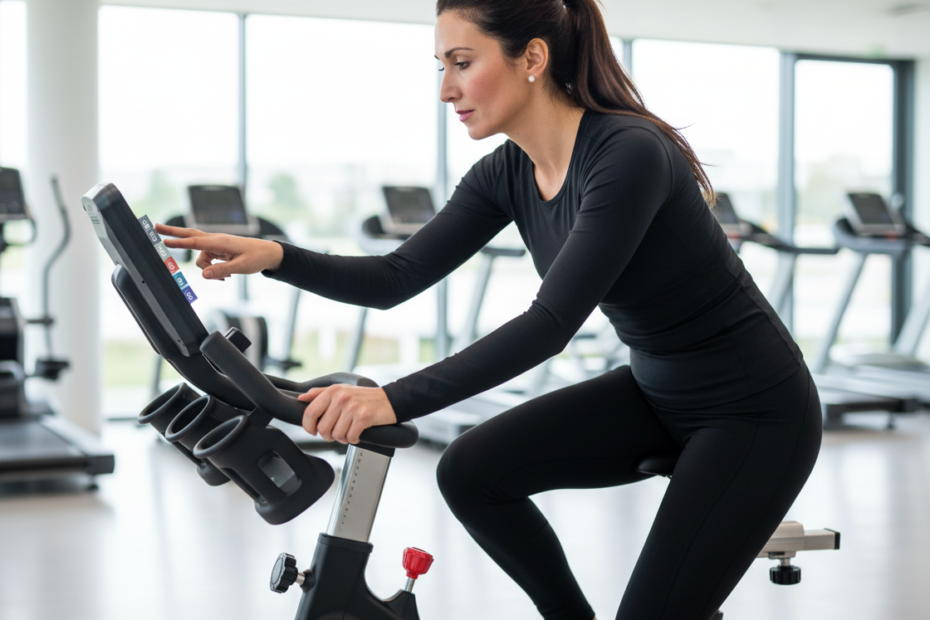
Starting a cycling program often confuses beginners about resistance settings. Most people simply guess, leading to workouts that are either too easy or impossibly difficult. The resistance dial isn’t just a random number—it’s actually a precise tool for controlling workout intensity. Finding that sweet spot where muscles are challenged without overtaxing the system requires some experimentation and understanding of basic principles. What most beginners don’t realize about resistance training is how dramatically it can transform their results.
Some of the links in this article may be affiliate links. If you make a purchase through these links, we may earn a small commission at no extra cost to you. Thank you.
Understanding Resistance Measurements on Static Bikes
How exactly do those numbers on your exercise bike translate to a workout?
When you adjust the resistance level on a static bike, you’re actually controlling magnetic braking that makes pedaling harder or easier.
Most bikes display resistance as simple numbered levels (1-20) or as watts produced.
The display accuracy varies between bike models, and sensor calibration can affect how reliable these numbers are.
Well, think of resistance like gears on a road bike—the higher you go, the more effort each pedal stroke requires.
What’s important is consistency.
A Level 10 on one machine might feel like Level 15 on another, so it’s probably best to track your personal progress on the same bike when possible.
Like climbing an increasingly steep hill, higher resistance at the same cadence means you’re generating more power with each rotation.
Understanding types of resistance systems will help you choose the best settings for your workouts.
Finding Your Optimal Starting Resistance Level
Finding your ideal starting point begins with baseline estimation—selecting a resistance level that allows you comfortably to complete 8-12 repetitions with proper form, roughly 40-60% of your estimated maximum capacity. During comfort testing, you’ll want to choose a weight that feels challenging but manageable. If you’re new to cycling, it’s best to err on the lighter side while you master proper technique. Can you complete the full range of motion without straining? That’s your sweet spot. It’s also important to remember that using an exercise bike offers low-impact cardiovascular exercise, which can be especially beneficial as you start your fitness journey. Track your performance over two consecutive sessions, and if you’re consistently hitting your target reps with good form, it’s probably time to increase by 2-5%.
Progression Techniques for Building Cycling Strength

The journey to cycling strength doesn’t happen overnight—it requires systematic progression that challenges your muscles to adapt over time.
Structuring your training in 3-4 week blocks allows you to focus on different aspects like hypertrophy, strength, and power phases, preventing those frustrating plateaus.
For effective tempo overload, try combining lower-body compound lifts with cycling-specific movements.
The eccentric focus—slowing down the lowering phase of movements—builds tremendous strength that translates directly to pedal power.
Track your progress consistently, whether it’s through increasing weights or monitoring your wattage output. Additionally, understanding aerodynamic drag can help you further refine your training for improved cycling efficiency.
Matching Resistance Settings to Different Workout Goals
Why does resistance level matter so much in your cycling workouts? Simply put, it determines what your body actually accomplishes during training. Proper program sequencing depends on matching resistance to specific fitness goals.
For strength development, cyclists should crank up resistance to 85-100% of their capacity for short, powerful intervals with longer rests—about 2-5 minutes between efforts.
Contrast this with hypertrophy training, which thrives in the moderate range (67-85%) with shorter recovery periods.
When planning your intensity mapping, consider that endurance work demands lighter resistance (40-60%) with higher repetitions.
Power training requires moderate-to-heavy loads moved explosively.
Actually, wait—it’s not just about the load but also the tempo.
Beginners should start conservatively around 60-70% of their capacity, as proper form is crucial before cranking things up.
Troubleshooting Common Resistance Adjustment Problems

Even with the perfect resistance plan in place, cyclists frequently encounter mechanical issues that can derail their training sessions.
When resistance dials move sluggishly, simple lubrication tips can work wonders—apply a small amount to tension mechanisms and check for any external obstacles blocking smooth movement.
For those mysterious resistance fluctuations mid-workout, calibration tricks are essential.
Try re-zeroing the console following manufacturer instructions, then test at known levels to verify accuracy.
It’s probably worth checking drive belts for slippage too.
If you’re seeing error codes like E01 when adjusting resistance, don’t panic!
Consult your manual’s error code table first, run any quick diagnostics suggested, and if problems persist, well, customer support might be your next stop.
Sometimes just reseating panels and resetting the console resolves these frustrating issues. Additionally, ensuring proper storage practices can prevent unnecessary damage to resistance components over time.
Frequently Asked Questions
How to Find Support and Resistance Levels for Beginners?
Beginners can locate price’s ceiling and floor by identifying visual cues in swing highs/lows, creating zones rather than precise points. Price psychology manifests through repeated touches and round number significance.
What Is the 3 5 7 Rule in Trading?
The 3-5-7 rule is a trading framework where traders risk 3% maximum per position, target 5 units of reward per unit of risk, across 7 trades maximum per timeframe application.
What Is the 2% Rule in Swing Trading?
The 2% rule in swing trading limits risk exposure by allocating only 2% of total capital to each trade through position sizing, protecting accounts from significant drawdowns during losing streaks.
How Do I Choose the Right Resistance Level?
Beginners should select resistance that allows completion of target reps with good form. Adjust based on volume confirmation across different time frames, starting with RPE 6-7 and increasing gradually when exercises become easier.