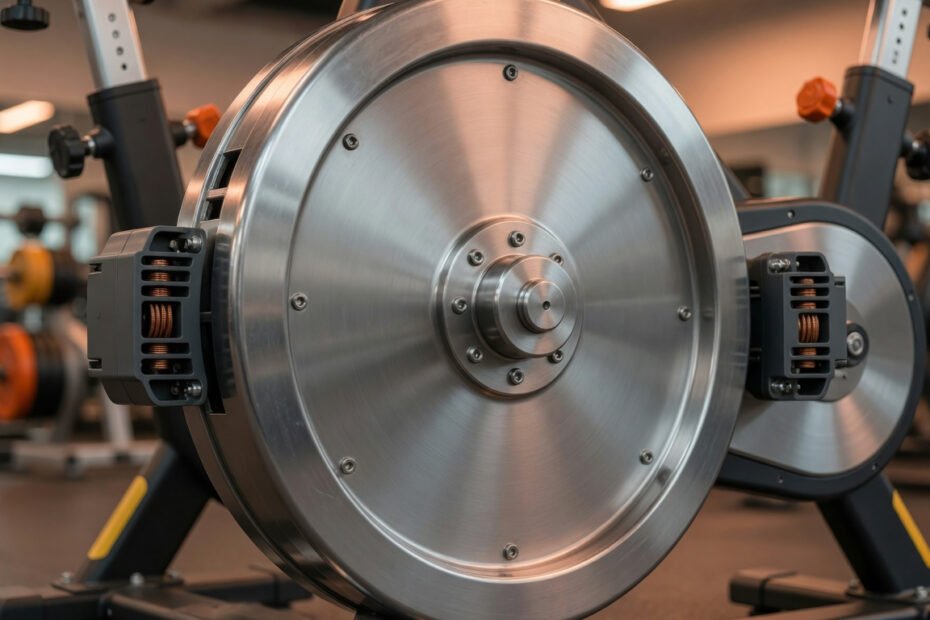
Yes — flywheel weight still matters with magnetic resistance, even though the magnets handle the difficulty side of things. The flywheel’s mass controls ride quality: how smooth the pedalling feels, how realistic the momentum is, and how well the bike holds up across everything from gentle warm-ups to full-on sprint intervals.
Some of the links in this article may be affiliate links. If you make a purchase through these links, we may earn a small commission at no extra cost to you. Thank you.
Key Takeaways
- Magnetic resistance controls difficulty independently of flywheel mass — but flywheel weight drives ride smoothness
- Heavier flywheels (15 kg and above) create more natural momentum and eliminate dead spots in your pedal stroke
- Budget magnetic bikes with flywheels under 8 kg often feel choppy, especially at low resistance settings
- Serious cyclists and HIIT riders benefit most from a flywheel in the 15–20 kg range
- Flywheel material, balance, and rim-weighting matter almost as much as the total mass figure
What Is a Flywheel and What Does It Actually Do?
A flywheel is a weighted disc — usually cast iron or machined steel — that sits at the front or rear of your exercise bike. When you start pedalling, your leg power transfers through the belt or chain and spins this disc. The heavier the disc, the more kinetic energy it stores while spinning.

Think of it like pushing a playground roundabout. A heavy one takes more effort to get moving, but once it’s spinning, it keeps going smoothly on its own momentum. A lightweight one starts easily but wobbles and slows the moment you ease off. Your flywheel behaves exactly the same way during your workout.
That stored rotational energy is what creates the smooth, continuous pedalling motion that makes a good exercise bike feel like real outdoor cycling — rather than the jerky, stop-start feeling you get from a poorly designed machine. Exercise physiologists consistently point to flywheel momentum as one of the primary factors separating premium indoor bikes from budget alternatives. It’s also why two bikes with identical resistance ranges can feel completely different the moment you start pedalling.
How Does Magnetic Resistance Actually Work?
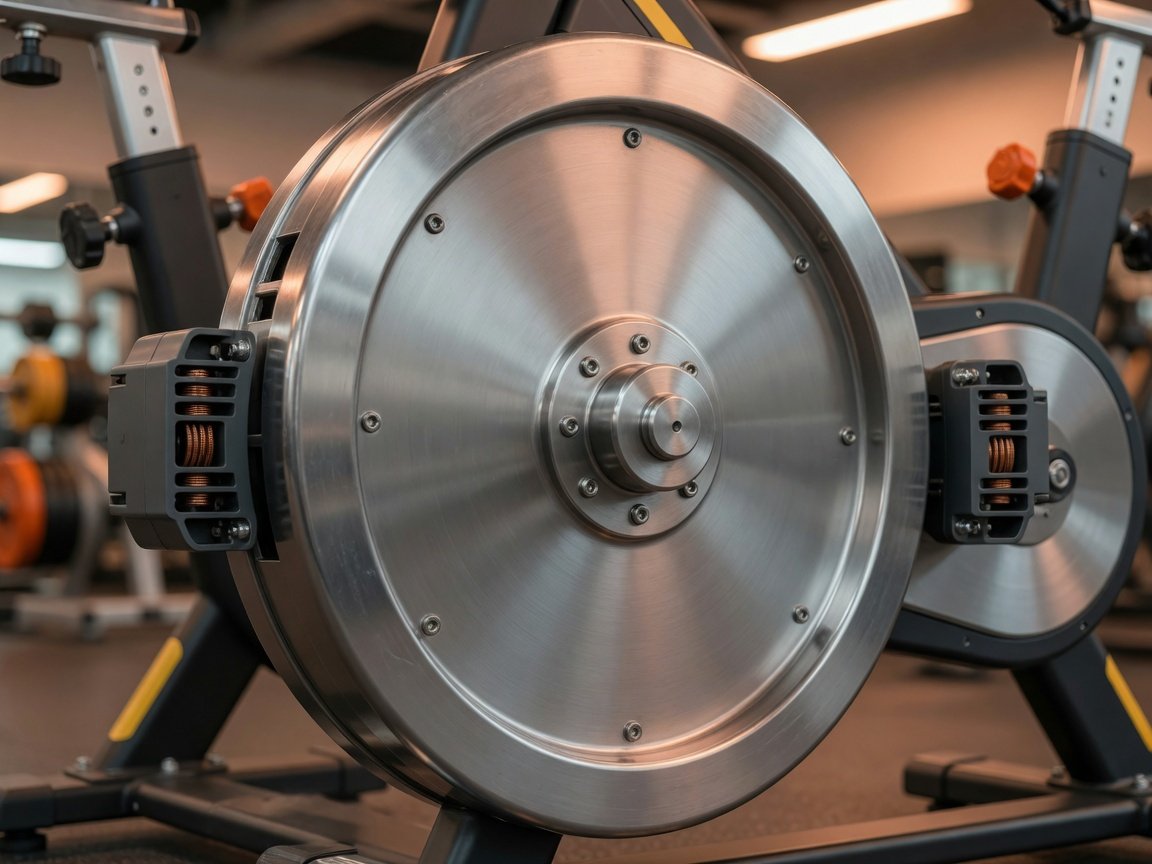
Here’s where it gets interesting — and where most of the confusion about flywheel weight starts. With magnetic resistance, there is no physical contact between the braking mechanism and the flywheel. Instead, magnets are positioned close to — but not touching — the spinning flywheel disc.
As the flywheel spins through the magnetic field, it generates what are called eddy currents — small electrical currents that circulate within the flywheel’s metal. These currents create their own opposing magnetic field, which pushes back against the flywheel’s rotation. That push-back is your resistance. Increase the magnetic field strength and you increase the resistance. Reduce it and pedalling becomes easier.
On consumer magnetic bikes, this is typically achieved by moving the magnets physically closer to or further from the flywheel via a tension knob or electronic motor. On higher-end electromagnetic systems, a computer-controlled coil changes the field strength instantly — which is how premium bikes deliver 24 or more precisely calibrated resistance levels at the push of a button.
One critical point: resistance level is determined entirely by magnet position and field strength — not by flywheel weight. A 6 kg flywheel and a 20 kg flywheel can both reach the same resistance level on paper. But they will not feel the same to ride. To see exactly how friction-free and quiet this system is, this deep dive into why magnetic drive bikes are so silent breaks down the mechanics in plain English.
So Does Flywheel Weight Still Matter With Magnetic Resistance?
Absolutely — just for different reasons than you might expect. The magnets decide how hard it is to pedal. The flywheel decides how smooth and natural it feels to pedal. Both matter enormously, and they are not interchangeable.
Here’s what flywheel weight actually controls on a magnetic resistance bike:
- Momentum between pedal strokes. Every pedal stroke has a power phase (the downstroke) and a recovery phase (the top and bottom of the arc). A heavier flywheel stores enough kinetic energy to carry you smoothly through the recovery phase. A lighter flywheel runs out of stored energy here, creating a noticeable dead spot where the pedals feel like they stall.
- Ride naturalness at low resistance settings. At minimal magnetic resistance, there is very little opposing force on the flywheel. If the flywheel is also light, the bike feels almost frictionless — fast and twitchy rather than controlled and road-like. A heavier flywheel provides its own natural resistance through inertia, filling in the gap the magnets leave at low settings.
- High-cadence stability. Sprint intervals and fast-paced HIIT sessions demand rapid cadence — often 90 to 110 RPM and above. A heavy flywheel stays stable at high RPM, whereas a light flywheel can develop micro-vibrations that affect your form and waste energy.
- Deceleration behaviour. When you ease off the pedals, a light flywheel decelerates quickly and suddenly. A heavy flywheel slows gradually, mimicking how a real bike continues rolling after you stop pushing. This deceleration quality is often what riders describe when they say a bike “feels like real cycling.”
- Resistance consistency throughout the pedal stroke. Because eddy currents within the flywheel generate the magnetic resistance, a denser and heavier flywheel can help deliver more linear and even resistance across the full 360° of your pedal rotation — not just the power phase.
The Ride Feel Difference: Light vs Heavy Flywheel on Magnetic Bikes
The real-world difference between a 6 kg flywheel and an 18 kg flywheel — both using magnetic resistance — is dramatic. Understanding this gap explains why one bike feels premium and another feels plasticky, even when they carry similar price tags or identical resistance level counts.
| Flywheel Weight | Typical Bike Category | Ride Feel | Best For |
|---|---|---|---|
| Under 7 kg | Budget entry-level | Choppy, noticeable dead spots, feels unstable at low resistance | Very light use, tight-budget beginners |
| 7–12 kg | Mid-range consumer | Acceptable smoothness at moderate intensity, some dead spots | Casual riders, 30–45 min steady-state cardio |
| 13–17 kg | Upper mid-range | Noticeably smoother, natural pedalling feel, solid HIIT capability | Regular riders, home spin sessions, beginner HIIT |
| 18–22 kg | Premium/studio | Road-like momentum, fluid transitions, excellent at all cadences | Serious cyclists, frequent HIIT, studio-quality training |
| 22 kg+ | Commercial/professional | Maximum smoothness, closest feel to real outdoor cycling | Advanced athletes, commercial gyms, professional training |
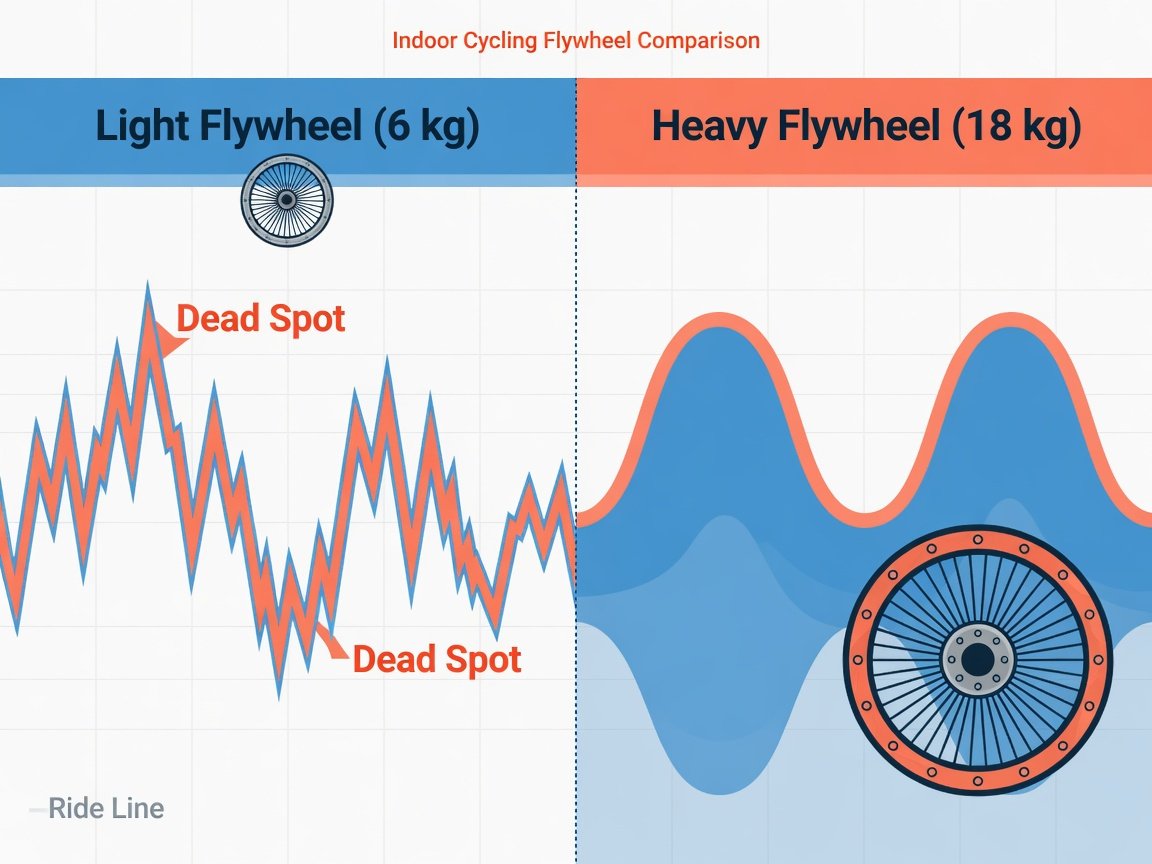
The smoothness gap between a 7 kg and a 20 kg flywheel is something most riders feel within the first 60 seconds on the bike. Jump on a premium studio bike and immediately think “this just feels different” — that’s flywheel weight doing most of the work. For more detail on how this plays out in practice, the guide on flywheel weight and ride smoothness covers the mechanics behind a professional-grade cycling feel.
How Heavy Should the Flywheel Be on a Magnetic Resistance Bike?
There is no single universal answer — it depends on how you train and what you want from your sessions. But there are solid general guidelines that fitness equipment specialists consistently agree on.
For casual, low-intensity riding: A flywheel in the 8–12 kg range is workable. If you plan on gentle 30-minute sessions at steady, moderate resistance, you won’t run into the worst limitations of a lighter flywheel. The ride won’t feel premium, but it will do the job for light general fitness use.
For regular, moderate-to-intense training: You want a minimum of 13–15 kg. At this weight, the flywheel has enough stored inertia to smooth out your pedal stroke during interval work and faster cadences. Exercise equipment testing consistently shows that 14 kg is approximately the threshold where most recreational cyclists stop noticing ride quality problems during normal-paced sessions.
For serious cyclists, spin class enthusiasts, or HIIT fans: Aim for 18 kg and above. Many popular premium indoor bikes — the kind used in professional cycling studios — use flywheels in the 18–20 kg range deliberately. The road-like momentum at this weight level makes high-cadence sprint work feel natural and controlled rather than jerky and unpredictable.
A note on “equivalent” flywheel systems: Some manufacturers use a rear-drive flywheel or a dual-flywheel design that distributes weight differently. In these cases, the combined effective weight and rim-weighting design matter more than the headline single-disc figure. Always check the full resistance system specification. If you’re ready to shop with this knowledge in mind, the best magnetic resistance bikes of 2026 includes detailed flywheel specs across all price points.
Does a Heavier Flywheel Make Magnetic Resistance Feel More Realistic?
Yes — and this is one of the most overlooked aspects of the flywheel weight conversation. Real outdoor cycling has natural momentum because you’re moving an entire bike plus your body weight forward through space. When you stop pedalling outdoors, that forward momentum carries you for several seconds. No exercise bike can fully replicate this, but a heavy flywheel gets closest.
Research into cycling biomechanics shows that the most efficient pedal technique engages muscle groups through the full 360° of the stroke — not just the downstroke. A heavy flywheel encourages this by carrying your pedals through the recovery phase rather than letting them stall, which naturally rewards a rounder, fuller pedalling action over time. Cyclists who train consistently on heavy-flywheel magnetic bikes often report measurable improvements in pedal stroke efficiency compared to lighter alternatives.
For HIIT-style training specifically, the flywheel’s stored kinetic energy becomes even more valuable. During a 20-second all-out sprint followed by a 10-second recovery, you want the flywheel to carry your momentum into the sprint rather than resist the sudden acceleration. A heavy flywheel acts like a power bank for your sprint energy — the transition from easy recovery pace to maximum effort feels fluid rather than mechanical. Getting your resistance settings right to extract maximum output from these efforts is its own skill, and this complete guide to perfecting your spin bike’s resistance covers five practical ways to optimise every level.
Does Flywheel Weight Affect How Quiet the Bike Is?
Magnetic resistance bikes are already the quietest type of indoor exercise bike available — because the magnets never physically touch the flywheel, there is zero friction noise from the resistance system. The main sound sources on any magnetic bike are the belt or chain drive, the bearings, and minor frame resonance at high speeds.
Flywheel weight itself does not directly make a bike louder. A heavier flywheel can actually contribute to a more stable, lower-frequency vibration profile compared to the higher-pitched wobble that very light, fast-spinning discs can develop at maximum cadence. In practical terms, the difference is barely noticeable — magnetic bikes are quiet regardless of flywheel weight, and most produce less noise than a normal conversation.
What affects noise far more than flywheel weight is whether the bike uses a belt drive or a chain drive. Belt-driven magnetic bikes are almost completely silent — ideal for early morning sessions, shared living spaces, or homes with thin walls. Chain-driven magnetic bikes are still far quieter than air resistance alternatives, but they produce a gentle mechanical sound at high cadence. Flywheel weight is a secondary noise factor at best, dwarfed by the drive system choice.
Who Actually Needs a Heavy Flywheel on a Magnetic Resistance Bike?
Not everyone needs an 18 kg flywheel — and paying for one when your training doesn’t demand it is money that could go toward better features elsewhere. Here’s a breakdown by rider type.
Casual Riders and Beginners
If you’re just getting started with indoor cycling and plan to ride at low-to-moderate intensity for general fitness, a flywheel in the 8–12 kg range is perfectly adequate. For 30–45 minute steady-state cardio sessions, the ride smoothness limitations won’t hold you back. Learning how to use the resistance system effectively matters more at this stage — this beginner’s guide to setting resistance levels is a good place to start.
Regular Home Cyclists
If you’re training 3–5 times a week and mixing steady-state cardio with occasional interval bursts, a 13–16 kg flywheel hits the sweet spot between cost and performance. You’ll notice significantly smoother pedalling than entry-level bikes, and the momentum holds up well during moderate intensity spikes without pushing the bike into premium pricing territory.
Serious Cyclists and HIIT Enthusiasts
This is the group that actually needs 18 kg or more. If you’re doing structured power training, virtual cycling platform workouts, sprint-heavy sessions, or you’re an outdoor cyclist using an indoor bike for off-season conditioning — flywheel weight will measurably affect your training quality. The road-like feel of a 20 kg flywheel supports the explosive, high-cadence pedalling these sessions demand and helps prevent technique degradation during hard efforts.
Weight Loss Focused Riders
If your primary goal is burning calories rather than athletic performance, flywheel weight matters less in absolute terms — but ride comfort matters more than most people realise. A smoother-feeling bike is easier to stay on for longer, and workout duration is the single biggest predictor of calorie expenditure on a stationary bike. A bike that actually feels good to ride keeps you on it instead of finding reasons to skip sessions.
The Material and Design of the Flywheel Matters Too
Flywheel weight is the headline number, but how that weight is distributed matters almost as much as the total mass. A well-engineered flywheel concentrates mass toward the outer rim — a design approach called high moment of inertia — which maximises the rotational energy stored per kilogram of flywheel weight.
A flat disc with mass evenly spread from centre to rim stores significantly less rotational energy than a rim-weighted disc of the same total weight. This is precisely why two bikes with identical flywheel weights can feel noticeably different to ride. A heavier flywheel with poor mass distribution can actually ride worse than a lighter flywheel with excellent rim-weighting engineering.
Cast iron flywheels are traditional and relatively inexpensive to produce, but machined steel flywheels are favoured in premium magnetic resistance bikes because they offer tighter tolerances, better balance, and more consistent surface properties for even eddy current generation. When comparing bikes, terms like “machined flywheel,” “precision-balanced flywheel,” or “CNC-finished flywheel” in the spec sheet are positive indicators of higher manufacturing quality — and they translate directly into a smoother, more consistent ride feel. For a full breakdown of how different magnetic resistance systems are engineered, the overview of magnetic resistance static bikes lays out what separates the different tiers of the market.
Frequently Asked Questions
Does flywheel weight matter more on magnetic resistance bikes or friction resistance bikes?
It matters significantly on both, but for different reasons. On friction resistance bikes — where felt or leather brake pads press directly against the flywheel — the flywheel’s mass contributes to both the resistance feel and the ride smoothness. The two are intertwined. On magnetic resistance bikes, the magnets control resistance completely independently of flywheel mass, so the flywheel only affects smoothness and momentum. Flywheel weight is arguably more critical to ride feel on magnetic bikes precisely because the flywheel isn’t doing any resistance work — its only job is to create a great pedalling experience.
Is a 6 kg flywheel good enough for a magnetic resistance bike?
It depends on how you train. A 6 kg flywheel on a magnetic resistance bike will feel noticeably choppy at low resistance settings and will develop dead spots during the recovery phase of your pedal stroke. For very light occasional use — short, low-intensity sessions a couple of times a week — it may be acceptable. For regular training, especially anything above moderate intensity or faster cadences, moving up to a minimum of 10–12 kg will make a significant and immediately noticeable difference to both your enjoyment and your results.
Can I add weight to my exercise bike’s flywheel?
Strongly not recommended. Flywheels are precision-balanced components — adding weight incorrectly creates imbalance, which causes vibration, premature bearing wear, and in more serious cases, genuine safety risks at high speeds. The flywheel spins at significant velocity during intense sessions, and an unbalanced disc puts stress on the entire drive system. If your current flywheel feels too light for your training needs, the right solution is to choose a better-specified bike rather than attempting to modify the existing one.
Does flywheel weight affect calorie burn on a magnetic resistance bike?
Not directly. Your calorie burn is determined by resistance level, pedalling speed, your body weight, and total workout duration. However, a heavier flywheel can indirectly affect calorie burn in two ways. First, it makes the bike more comfortable to ride for extended periods, which keeps you training longer. Second, it encourages a fuller, more efficient pedal stroke through the complete 360° rotation — engaging more muscle mass including glutes, hamstrings, and hip flexors — which can lead to slightly higher calorie expenditure at the same perceived effort level.
What flywheel weight do studio-quality indoor bikes typically use?
Premium studio-quality indoor bikes consistently use flywheels in the 17–22 kg range. This weight class is deliberately chosen to deliver the smooth, road-like momentum that keeps riders engaged through long and demanding sessions. When you try one of these bikes and immediately notice it feels fundamentally different from a home machine, the flywheel weight is a major part of the reason. Budget home bikes with magnetic resistance often use 6–10 kg flywheels to keep costs down — and that gap in feel is immediately apparent when you compare them side by side.
Is flywheel weight the single most important factor when buying a magnetic resistance bike?
It is one of the most important factors, but it operates as part of a package. Drive system quality (belt vs chain), resistance range and precision, seat and handlebar adjustability, frame rigidity, and overall build quality all play important roles. Flywheel weight is probably the specification that most directly separates a great-feeling bike from a frustrating one — but a 20 kg flywheel cannot save a bike with a poorly calibrated resistance system or a wobbly, flexing frame. Look for a balanced package where the flywheel weight is consistent with the overall build quality and engineering standard of the machine.
The Bottom Line
Flywheel weight absolutely matters on magnetic resistance bikes — just not for controlling resistance. The magnets handle that job. What the flywheel does is give your ride its character: smooth or choppy, road-like or mechanical, fluid or stop-start. These qualities directly affect how long you’ll want to ride, how your pedalling technique develops over time, and ultimately how much you actually use the bike you paid for.
Here’s a quick guide to hitting the right specification:
- Casual beginner: 8–12 kg is workable — prioritise other features at this stage
- Regular home rider: 13–16 kg is the sweet spot for cost versus performance
- Serious cyclist or HIIT enthusiast: 18 kg and above for genuine studio-quality feel
- Always check flywheel design, not just weight: a rim-weighted, precision-machined flywheel punches well above its weight class on the spec sheet
- Pair flywheel weight with overall build quality: a heavy flywheel in a low-quality frame delivers less than a well-engineered lighter alternative
Don’t let a low flywheel weight get buried under impressive resistance level counts or slick marketing language. Flywheel weight is one of the clearest indicators of how an exercise bike will actually feel to use every single day — and how long you’ll keep coming back to it.