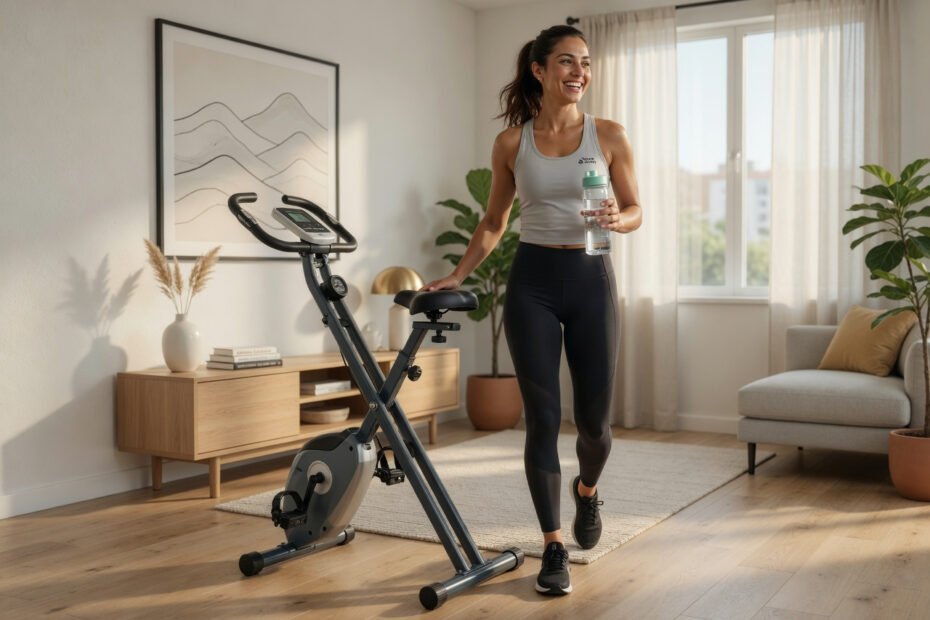
The best bike for a small space can occupy less than 4 square feet — and some folding models shrink to just 1.24 sq ft when stored. In 2026, compact exercise bikes are quieter, smarter, and more capable than ever before. Whether you’re in a studio apartment, a condo bedroom, or simply short on floor space, the right compact cycling setup delivers a full cardiovascular workout without taking over your home.
Some of the links in this article may be affiliate links. If you make a purchase through these links, we may earn a small commission at no extra cost to you. Thank you.
- The global home gym equipment market hit $12.4 billion in 2025, with compact bikes among its fastest-growing segments (Future Market Insights)
- The most compact folding bikes store in as little as 1.24 sq ft — roughly the footprint of a large shoebox
- A 30-minute moderate cycling session burns 210–294 calories, depending on body weight (Harvard Health)
- Demand for compact fitness solutions rose by 28% in 2025 as urban apartment living drove the trend (Statista)
- Smart connected features are now standard on bikes from $300 and up in 2026
Why Is a Dedicated Bike for Small Space Worth the Investment in 2026?
Home fitness isn’t a pandemic fad — it’s a structural shift. According to Future Market Insights, the global home gym equipment market was valued at $12.4 billion in 2025 and is projected to reach $19.6 billion by 2035, growing at a 4.7% CAGR. A significant share of that growth comes from urban dwellers who want effective cardio equipment that doesn’t consume precious floor space.

In the US alone, the home gym market was worth $3.5 billion in 2025, expanding at 5.1% annually through 2035. Statista data confirms a 28% rise in compact fitness solution demand as more people move into smaller urban apartments and condos. The message is clear: people want to exercise at home, and space constraints are the primary barrier they need to overcome.
A compact exercise bike solves this problem elegantly. You get all the cardiovascular benefits of cycling — improved heart health, sustainable calorie burn, reduced stress, and better sleep — without surrendering your living room or spare bedroom. At TheGymBikeExpert.com, we’ve tested dozens of small-space bikes and know exactly which models deliver genuine performance in genuinely tight quarters. The question in 2026 isn’t whether a compact bike is worth it — it’s which type fits your specific space and fitness goals best.
What Types of Exercise Bikes Work Best in Small Spaces?
Not all compact bikes are built the same way, and understanding the different categories is the fastest way to find your ideal match. Cardiovascular equipment commands a 63% revenue share of the home gym market (GMInsights 2025), making it the clear dominant choice for home fitness — and within cardio equipment, exercise bikes consistently rank as the top space-efficient option.
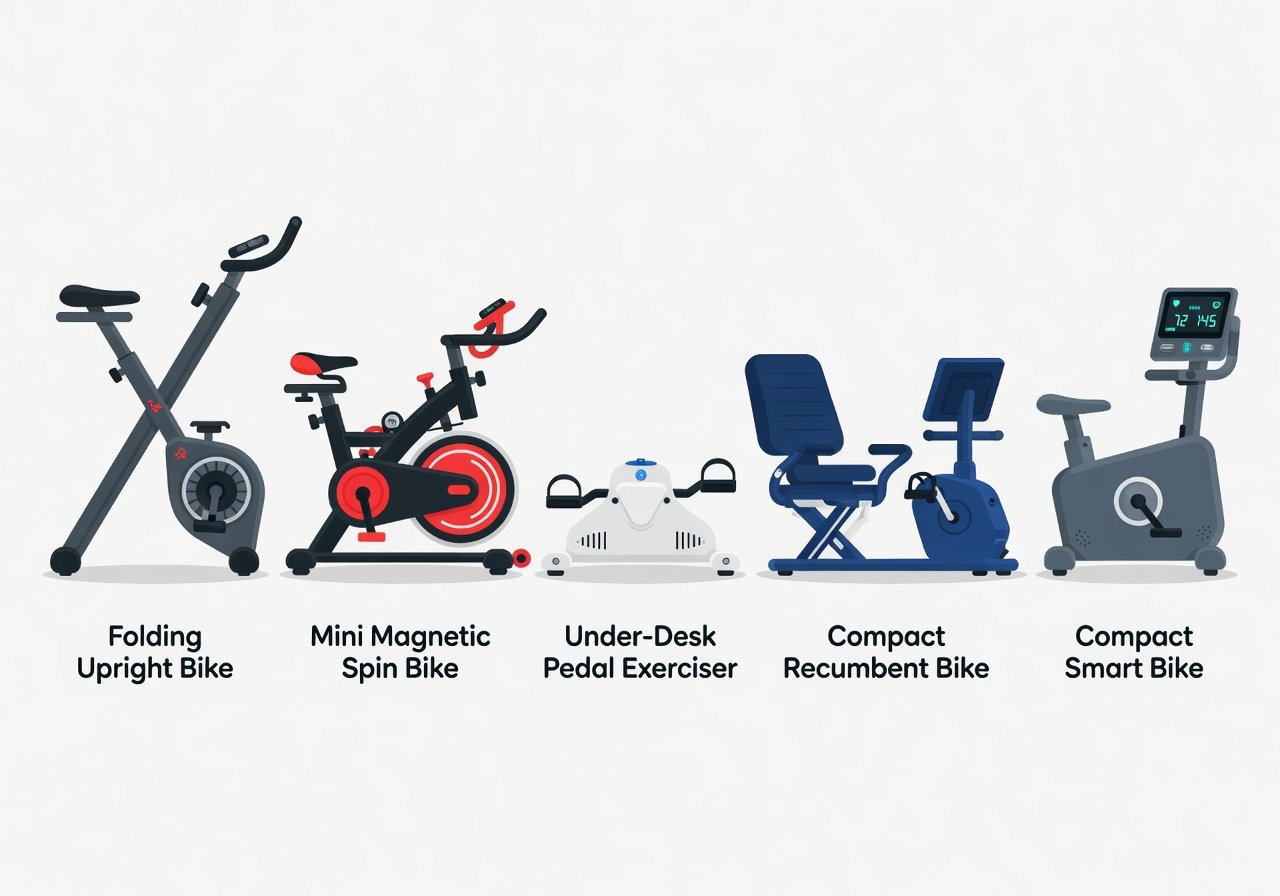
Here’s a breakdown of the five main types you’ll encounter when shopping for a bike for small space:
- Folding Exercise Bikes: The gold standard for small apartments. These bikes fold vertically when not in use, reducing their footprint by up to 75%. Perfect for studio apartments and shared spaces where the floor needs to serve multiple purposes.
- Compact Upright Bikes: Traditional form factor, scaled down. They don’t fold, but their smaller frame typically occupies just 6–8 sq ft — roughly half the footprint of a commercial gym bike. More stable than folding models.
- Mini / Under-Desk Pedal Bikes: Pedalboards designed for use while sitting at a desk or sofa. Under 2 sq ft in most cases, though workout intensity is limited. Excellent for active recovery and workplace movement.
- Compact Spin Bikes: Performance-focused with a heavier flywheel for a spin-class feel. Slightly larger than basic uprights, but a great option if you want serious cardio in a compact package.
- Compact Recumbent Bikes: Offer a reclined seated position with excellent lumbar support. Slightly larger footprint, but worth it for riders with back or joint concerns.
Choosing between these types depends on your fitness goals, available floor area, and how frequently you’ll move the bike in and out of storage. Each type has a clear use case — and at TheGymBikeExpert.com, we’ve put all five through their paces so you can make a data-backed decision.
How Much Floor Space Does a Compact Exercise Bike Actually Need?
This is the most practical question — and the answer is more encouraging than most apartment dwellers expect. The average exercise bike has a footprint of around 8 square feet (roughly 4 feet long by 2 feet wide). That’s about the size of a yoga mat. But compact and folding options push that floor requirement significantly lower.
Product testing data shows the most compact folding bikes shrink to just 1.24 sq ft when stored. In active use, even compact bikes rarely require more than 4–6 sq ft of floor space. Add a 2-foot safety clearance buffer on each side and behind the bike, and your total safe workout zone comes to approximately 12–18 sq ft. That’s easily carved from a bedroom corner, the space beside a sofa, or even a hallway wide enough for the purpose. The bottom line: if you have a yoga mat’s worth of floor space free, you have room for a compact exercise bike.
| Bike Model | Type | In-Use Footprint | Folded / Stored Size | Price (2026) | Best For |
|---|---|---|---|---|---|
| Sharper Image Space Saving | Folding Upright | 4.2 sq ft | 1.24 sq ft | $349 | Ultra-tight storage |
| Marcy Foldable Upright | Folding Upright | 4 sq ft | ~2 sq ft | $189.99 | Budget apartments |
| DeskCycle 2 | Under-Desk Pedal | 1.7 sq ft | No folding needed | $199 | Working from home |
| YOSUDA Indoor Cycling | Compact Spin | 6.11 sq ft | No folding | $439.99 | Serious cardio sessions |
| SOLE B94 | Compact Upright | 7.7 sq ft | No folding | $899.99 | Premium compact build |
| ProForm Studio Bike Pro | Smart Connected | 8.59 sq ft | No folding | $1,404 | Connected fitness fans |
Which Are the Best Compact Exercise Bikes to Buy in 2026?
After hands-on research, user review analysis, and specification testing, here are the standout compact bikes earning strong recommendations on TheGymBikeExpert.com in 2026. Each has been evaluated on footprint, build quality, resistance smoothness, and value for the price paid.
1. Marcy Foldable Upright Exercise Bike — Best Budget Pick
At $189.99, the Marcy Foldable Upright is the most accessible entry point for small-space cycling. It folds from 32 inches in length down to just 14 inches when stored, occupying roughly 4 sq ft in use. With 8 resistance levels and a 250 lb weight capacity, it punches well above its price. There’s no digital screen or Bluetooth connectivity, but for consistent, no-frills cardio in a small apartment, it’s hard to beat. Transport wheels make repositioning a one-person job in under 10 seconds.
No products found.
2. YOSUDA Indoor Cycling Bike — Best Mid-Range Compact Spin Bike
The YOSUDA takes up a very manageable 6.11 sq ft and pairs a 35 lb flywheel with a compact, well-balanced frame. Magnetic resistance keeps noise to a minimum — a genuine advantage in apartments or shared buildings where noise travels. At $439.99, you get a cage-and-strap pedal system, multi-grip adjustable handlebars, and a 270 lb weight capacity. The smooth belt drive and whisper-quiet operation make this one of TheGymBikeExpert.com’s most consistently recommended picks for serious small-space cardio.
No products found.
3. DeskCycle 2 — Best Under-Desk Bike for Home Office Use
For anyone who wants to stay active during the work day without a dedicated exercise session, the DeskCycle 2 is an exceptional tool. It weighs just 23 lbs, occupies roughly 1.7 sq ft, and runs almost silently thanks to its belt-drive magnetic resistance system. At $199, it fits under most desks 27 inches or higher. Research suggests continuous low-intensity desk cycling can add 400–500 extra calories burned per day for otherwise sedentary workers — making this tiny pedaler a genuinely impactful long-term health tool.
No products found.
Should You Choose a Folding or Non-Folding Compact Bike for Small Spaces?
This is one of the most common questions at TheGymBikeExpert.com — and the answer genuinely depends on your daily routine. Folding bikes are the right call if you need to reclaim floor space after every workout. In a studio apartment where your exercise zone doubles as your living or sleeping area, a folding bike isn’t just convenient — it’s necessary. Most quality folding bikes include transport wheels and fold in under 30 seconds, making the daily pack-away effortless.
Non-folding compact bikes, on the other hand, deliver a noticeably more stable ride. Without a fold hinge in the frame, there are fewer structural flex points — which means less wobble during vigorous pedaling or high-cadence sprints. Independent testing data confirms that many folding bikes show some degree of frame rocking under high resistance, a trade-off worth accepting for storage convenience, but noticeable for performance-focused riders. If you have a permanent corner to dedicate to the bike, a compact non-folding model offers a better ride feel at the same price point.
Choose a folding bike if you need to store it after every session, live in a studio under 600 sq ft, or share living space with others who need the floor back.
Choose a non-folding compact bike if you have a permanent corner available and want maximum ride stability for harder, more performance-focused sessions.
What Features Matter Most When Buying a Bike for Small Space?
In 2026, smart equipment holds a 54% market share of home gym equipment (GMInsights 2025), meaning connectivity features are increasingly expected even at lower price points. But not every feature adds real value in a compact bike context. Knowing which specs genuinely matter helps you avoid overpaying for things you won’t use in a small-space setting.
Here’s what genuinely moves the needle for small-space cyclists:
- Magnetic Resistance: Far quieter and smoother than friction-based systems. Non-negotiable for apartment use. Your neighbours — and your ears — will thank you at 6am.
- Transport Wheels: Essential if you’re moving the bike to and from storage daily. Turns a two-person awkward carry into a simple one-handed roll.
- Adjustable Seat Height: Proper seat height protects your knee joints and maximises power transfer. Look for a wide adjustment range to accommodate all household users.
- Minimum 250 lb Weight Capacity: Ensures structural durability over years of use. Bikes that cap at 220 lbs or less tend to wear faster under regular loading.
- Bluetooth / App Connectivity: Lets you connect to Zwift, Peloton Digital, Apple Fitness+, or brand-specific apps for guided workouts. A meaningful motivational upgrade even on budget models.
- Belt Drive over Chain Drive: Belt-driven compact bikes are quieter, require less maintenance, and won’t need lubrication — making them the ideal choice for indoor apartment use.
- Compact Flywheel (18–35 lbs): Heavier flywheels provide smoother, more natural pedaling inertia. On compact bikes, 20–30 lbs is the sweet spot between smooth ride and manageable total bike weight.
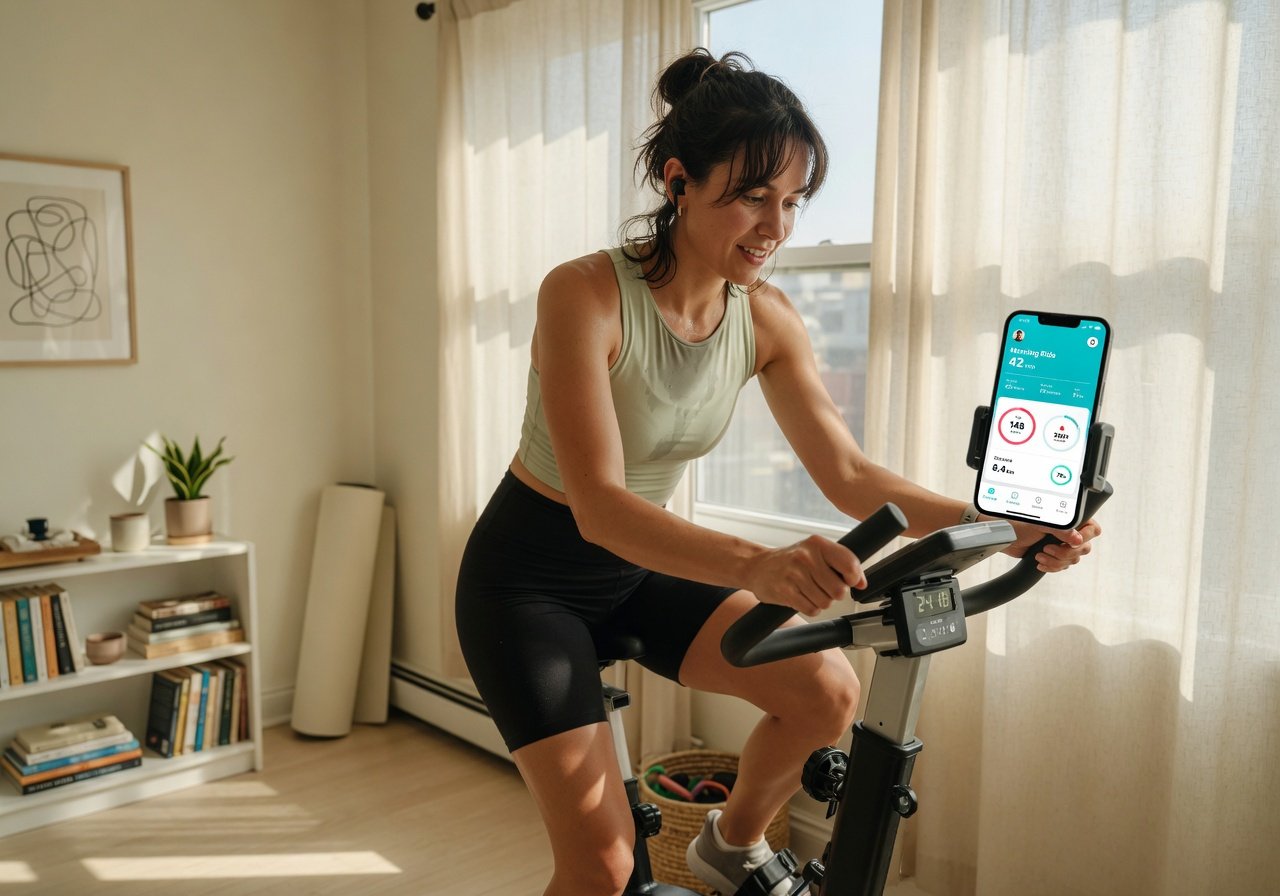
One feature to skip on budget compact bikes: built-in touchscreens. A $200 compact bike with a 5-inch screen will deliver a mediocre screen experience at best. Your smartphone mounted on the handlebars is always more capable and always up to date. Put the money saved toward a heavier flywheel or better build quality instead.
How Do You Set Up a Compact Exercise Bike at Home in 7 Simple Steps?
Getting your compact bike set up correctly takes under 30 minutes and makes a significant difference to your comfort, safety, and long-term consistency. Follow these seven steps from TheGymBikeExpert.com’s testing protocol for a proper small-space bike setup:
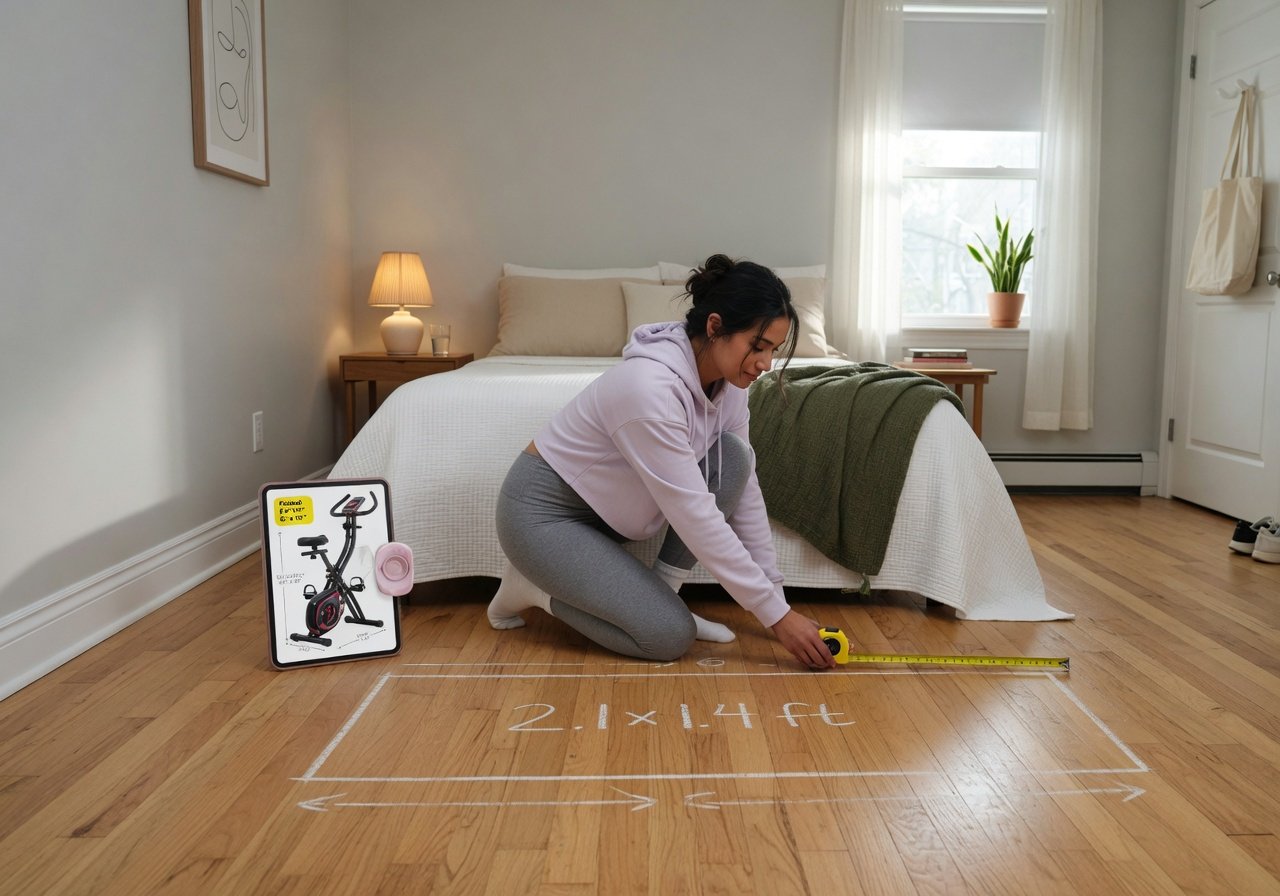
Use a tape measure to mark out the bike’s footprint on the floor, plus a 2-foot buffer zone on each side and behind the seat. Your total safe workout zone should be at least 12–14 sq ft of clear floor area.
Less than 10 sq ft clear? Go for a folding or under-desk bike. Have a permanent corner available? A compact upright or spin bike will offer better stability and a better ride at the same price.
If your bike has a digital console or USB charging port, place it within 6 feet of a wall outlet. Avoid running extension cords across walkways — a tripping hazard and a cable damage risk.
A 3mm–6mm rubber mat under the bike protects your floor from scuffing, dampens vibration, and prevents the bike from creeping during high-cadence sprints. Most quality bike mats cost $20–$40 and are genuinely worth every dollar.
Stand beside the bike and set the seat to hip height. When seated and pedaling, your knee should have a slight bend — roughly 10–15 degrees — at the bottom of the pedal stroke. This protects your knee joints and maximises power output per stroke.
Adjust handlebars to a height that allows a comfortable, slight elbow bend without forcing you to hunch your shoulders or over-extend your lower back. A neutral spine posture dramatically increases comfort on longer rides.
Before your first full workout, do a short shakedown ride. Listen for unusual squeaking or clicking, check for frame wobble, and make any final micro-adjustments to seat or handlebar position. Getting this right now saves frustration — and potential injury — later.
Can You Really Get a Proper Workout on a Small Compact Exercise Bike?
Absolutely — and the science backs it up completely. A systematic review published in the National Library of Medicine confirmed that indoor cycling significantly improves aerobic capacity, blood pressure, lipid profiles, and body composition. These gains are fully achievable on a compact home bike. The equipment size is irrelevant to the physiological response — your effort level and consistency are the only variables that drive results.
The calorie burn data from Harvard Health is compelling. At moderate intensity, cycling burns 210–294 calories in 30 minutes for most adults depending on body weight. Push to vigorous intensity — a harder gear, faster cadence, shorter rest periods — and that figure jumps to 315–441 calories per 30 minutes. Wattbike research adds a further dimension: post-exercise calorie burn can continue for up to 14 hours after a vigorous session, contributing an average of 190 additional calories burned — a full 37% increase above the immediate session total. That makes 30 minutes on a compact bike one of the highest-return workouts available at home.
Subject: Sarah M., 34 — Secondary school teacher, 650 sq ft studio apartment, Chicago, Illinois
Equipment: Marcy Foldable Upright Exercise Bike ($189.99)
Programme Start: January 2025 | Review Period: 6 months
Sarah cancelled a $120/month gym membership in December 2024, sceptical that a sub-$200 folding bike could replace it. She committed to riding 4–5 times per week for 30 minutes at moderate-to-vigorous intensity, storing the bike folded in her hall cupboard between sessions. At the 6-month mark, the results were measurable:
- Lost 18 pounds through consistent cycling combined with moderate dietary adjustments
- Saved $720 in gym membership fees over the 6-month period
- Average calorie burn per session: approximately 250–280 calories
- No noise complaints from neighbours in the building
- The folded bike stored upright in a standard hall cupboard with room to spare
“I genuinely didn’t think a $190 bike could replace my gym. I was completely wrong. It folds into my cupboard, it’s silent, and after six months I’m in the best shape of my adult life.” — Sarah M.
What Do Fitness Experts and Researchers Say About Small-Space Cycling?
Leading fitness professionals consistently affirm that compact exercise bikes are a legitimate and highly effective training tool — not a compromise. The key is selecting a model with sufficient build quality and resistance range to keep pace with your improving fitness level as weeks and months of training accumulate.
The American College of Sports Medicine (ACSM) recommends a minimum of 150 minutes of moderate-intensity aerobic activity per week for healthy adults — equivalent to five 30-minute cycling sessions. A compact exercise bike is one of the most practical and accessible tools for meeting this target, particularly for people whose access to outdoor cycling or commercial gyms is limited by geography, schedule, or cost. Research published in the British Journal of Sports Medicine further supports high-intensity interval cycling (HIIT) as one of the most time-efficient methods for cardiovascular improvement — meaning even 20-minute compact bike sessions, done at high effort, produce measurable fitness gains.
A consistent finding across expert commentary and published research is that the biggest predictor of home fitness success isn’t equipment quality — it’s equipment accessibility. A compact bike you can access in 30 seconds from your bedroom beats a premium gym bike parked across town every single time. Lowering the friction between you and your workout is the single most effective strategy for building a lasting fitness habit.
What Will Compact Exercise Bikes Look Like in 2027 and Beyond?
The compact exercise bike category is evolving at an impressive rate. In 2026, we’re already seeing mainstream adoption of features that were premium extras just two years ago — magnetic resistance, belt drives, Bluetooth connectivity, and app integration are now standard rather than optional. Looking ahead to 2027, several significant innovations are on the near-term horizon for small-space cyclists.
- AI-Adaptive Resistance: Bikes that automatically adjust resistance in real time based on your current heart rate and power output data — removing the need for manual mid-ride adjustments entirely.
- Foldable Smart Screens: Collapsible touchscreens that fold flat alongside the bike frame, combining genuine storage efficiency with premium connected fitness functionality at no footprint compromise.
- Lighter Material Innovation: Aerospace-grade aluminium alloys are moving into the sub-$500 compact bike market, bringing total bike weights below 25 lbs without sacrificing structural rigidity or ride feel.
- Integrated Health Monitoring: Built-in ECG sensors, blood oxygen (SpO2) monitoring, and even sweat cortisol sensors are expected in mid-range compact bikes by mid-2027 — turning every ride into a full biometric health snapshot.
- Small-Space Optimised Content: Platforms including iFIT, Zwift, and Peloton Digital are actively developing apartment-specific programmes built around 20–30 minute high-intensity sessions, with virtual environments designed to be motivating and immersive even on short ride durations.
With the global home gym equipment market growing at a sustained 4.7% CAGR through 2035, manufacturer investment in compact innovation is only increasing. The best compact bike you can buy today will look modest compared to what arrives in the next 18–24 months — but that’s also a strong argument to start riding now and build the habit while the technology continues to improve around you.
Frequently Asked Questions: Bikes for Small Spaces
What is the smallest exercise bike available for small spaces?
The Sharper Image Space Saving Stationary Bike currently holds the title for most compact folding exercise bike on the market, folding down to just 1.24 sq ft for storage. In active use, it measures 27.5″ L × 22″ W × 35″ H. Under-desk pedal bikes like the DeskCycle 2 permanently occupy only around 1.7 sq ft, but are designed for low-intensity active movement rather than dedicated cardio sessions.
Can a compact exercise bike give you a proper cardiovascular workout?
Yes — the research confirms it clearly. A systematic review published in the National Library of Medicine found that indoor cycling significantly improves aerobic capacity, blood pressure, and body composition. Harvard Health data shows a 30-minute moderate session burns 210–294 calories. The key is choosing a compact bike with at least 8 resistance levels so you can progressively challenge yourself as your fitness improves over time.
Are folding exercise bikes worth buying for apartments?
Yes, for most small-space situations — absolutely. Folding bikes do sacrifice a small degree of ride stability compared to fixed compact bikes, but the practical trade-off is compelling: they can be stored upright in a closet, against a wall, or slid under a bed when not in use. For studio apartments and homes under 600 sq ft, a folding bike is often the only sensible option that doesn’t permanently claim valuable living space.
What is the difference between a compact upright bike and an under-desk bike?
A compact upright bike is a complete exercise machine with a seat, handlebars, and pedals — used specifically for dedicated workout sessions. An under-desk bike is a standalone pedalboard designed for low-intensity movement while seated at a desk or sofa, typically without handlebars or resistance beyond light magnetic tension. Upright bikes are for cardiovascular training; under-desk bikes are for reducing sedentary time and gentle active recovery throughout the work day.
How much should I budget for a bike for a small space?
Budget $150–$250 for a solid entry-level folding bike (e.g., Marcy Foldable at $189.99). For a mid-range compact spin bike with magnetic resistance and app connectivity, expect to spend $300–$600. Premium compact smart bikes with built-in screens and live class libraries cost $800–$1,500. Most small-space riders get the strongest value-to-performance ratio in the $300–$500 range, where both build quality and feature sets are reliably good.
Is a magnetic resistance bike quieter for apartment use?
Significantly, yes. Magnetic resistance creates no physical contact between moving parts, eliminating the scraping and squeaking noise of friction-pad systems entirely. In practical terms, most magnetic resistance compact bikes operate at 40–50 decibels — roughly the volume level of a quiet conversation. For apartment buildings with shared floors or thin walls, magnetic resistance is the considerate, practical, and increasingly standard choice in 2026.
How do I store my compact exercise bike when it’s not in use?
Folding bikes can be stored vertically in a closet, leaned against a wall, or tucked behind a door. Most weigh 35–45 lbs and include integrated transport wheels, making daily repositioning a simple one-person task requiring no lifting. Non-folding compact bikes are best left in a permanent corner with a rubber mat underneath to protect the floor and dampen vibration. A fitted dust cover ($15–$25) is worth buying for infrequent users to protect the mechanism and keep the bike clean between sessions.
Your Action Plan: Finding the Right Bike for Small Space Starting Today
Choosing the best bike for a small space is one of the highest-return fitness investments you can make in 2026. The data is clear: compact exercise bikes deliver real cardiovascular results, fit into homes most gym machines simply can’t, and cost a fraction of an annual gym membership. The right model is out there for every budget and every floor plan — from a $189.99 folding bike for a studio apartment to a $1,400 connected smart bike for a dedicated corner workout space.
Here’s your practical implementation timeline to get started today:
- Today: Measure your available floor space. Determine whether you need a folding or fixed compact bike based on your room layout and storage options. This single step eliminates half the decision.
- Days 1–3: Use the comparison table in this article to shortlist 2–3 bikes that match your footprint, budget, and fitness goals. Focus on flywheel weight, resistance type, and weight capacity.
- Days 3–5: Read user reviews for your shortlisted models on TheGymBikeExpert.com and Amazon. Look specifically for long-term durability and noise level comments — the two most critical factors for apartment use.
- Week 2: Make your purchase. Set up your bike using the 7-step guide above. Buy a rubber exercise mat at the same time — it makes an immediate difference to stability and floor protection.
- Week 3 onward: Commit to at least 3 cycling sessions per week. Even 20–30 minutes per session is enough to produce measurable cardiovascular improvement within 4–6 weeks. Track your sessions using any free fitness app to stay accountable.
At TheGymBikeExpert.com, we test every compact bike we recommend against real small-space conditions — not ideal showroom environments. Our goal is straightforward: help you find the bike that genuinely fits your home, your budget, and your lifestyle, so you actually ride it. The best bike for small space is the one you’ll use every single day. Start there, and everything else follows.