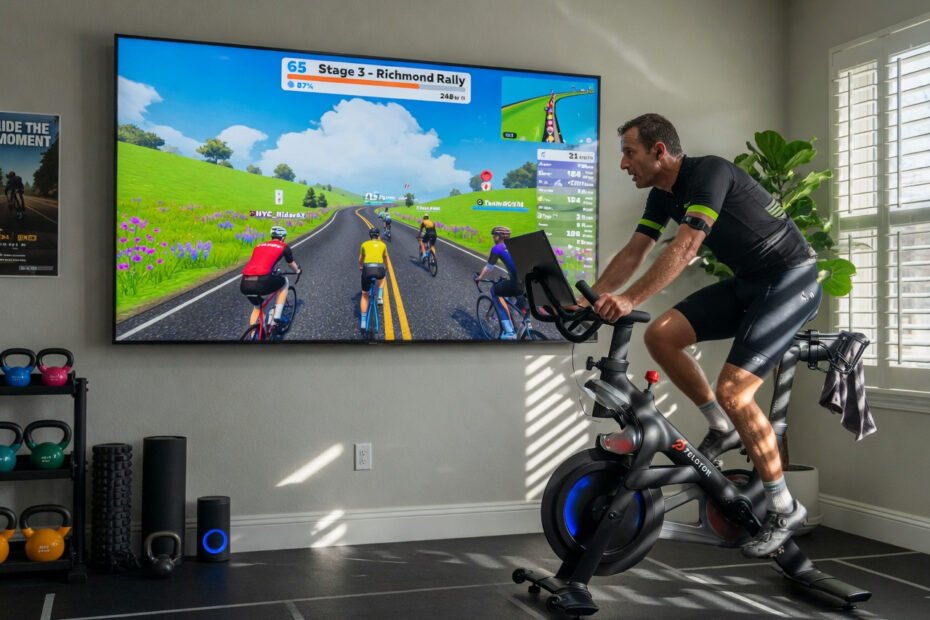
Virtual cycling lets you ride indoors on a smart trainer or connected exercise bike while a platform like Zwift, Rouvy, or Wahoo SYSTM simulates real-world routes and adjusts your resistance automatically. You get the full experience — climbs, sprints, group rides — without leaving home. In 2026, it’s faster, more social, and more affordable than ever to get started.
Some of the links in this article may be affiliate links. If you make a purchase through these links, we may earn a small commission at no extra cost to you. Thank you.
📋 Quick Summary: What You’ll Learn
- Market momentum: Virtual cycling platform subscriptions grew 28% globally in 2025, with over 4 million active users worldwide — and adoption is accelerating into 2026.
- Low barrier to entry: A smart trainer, a compatible device, and a subscription starting at $13/month is all you truly need to get started.
- Proven adherence gains: Research shows virtual cyclists train up to 43% more frequently than solo indoor riders, thanks to gamification and real-time social features.
- The Gym Bike Expert recommends: Zwift for beginners who want fun and community; TrainerRoad for data-driven athletes chasing measurable performance improvements.
What Is Virtual Cycling and How Does It Actually Work?
Virtual cycling bridges the gap between indoor training and the outdoor riding experience you love. It connects your smart trainer or smart bike to a companion app via Bluetooth or ANT+ wireless protocols. The app reads your real-time power output, cadence, and speed — then pushes resistance changes back to your trainer automatically.

The result? When a 10% gradient appears on screen, your legs actually feel it. This feature — called simulation mode — is what separates virtual cycling from simply pedalling a stationary bike while watching TV. There’s also ERG mode, which locks your resistance at a specific power target for structured interval training.
Platforms like Zwift render fully three-dimensional worlds populated with thousands of other real riders. Your avatar moves at exactly the speed your power output dictates. Real aerodynamics are modelled too — heavier riders gain momentum on descents while lighter riders climb faster. It’s physics-accurate, not just cosmetically immersive.
According to Grand View Research, the global indoor cycling equipment market reached $2.1 billion in 2025, driven primarily by smart trainer adoption and the rapid growth of connected fitness platforms. That figure is projected to reach $3.4 billion by 2027 — a trajectory that confirms virtual cycling is firmly mainstream, not niche.
Global indoor cycling equipment market value in 2025 — projected to reach $3.4 billion by 2027 as virtual platforms drive hardware upgrades worldwide.
Source: Grand View Research, Indoor Cycling Equipment Market Report, 2025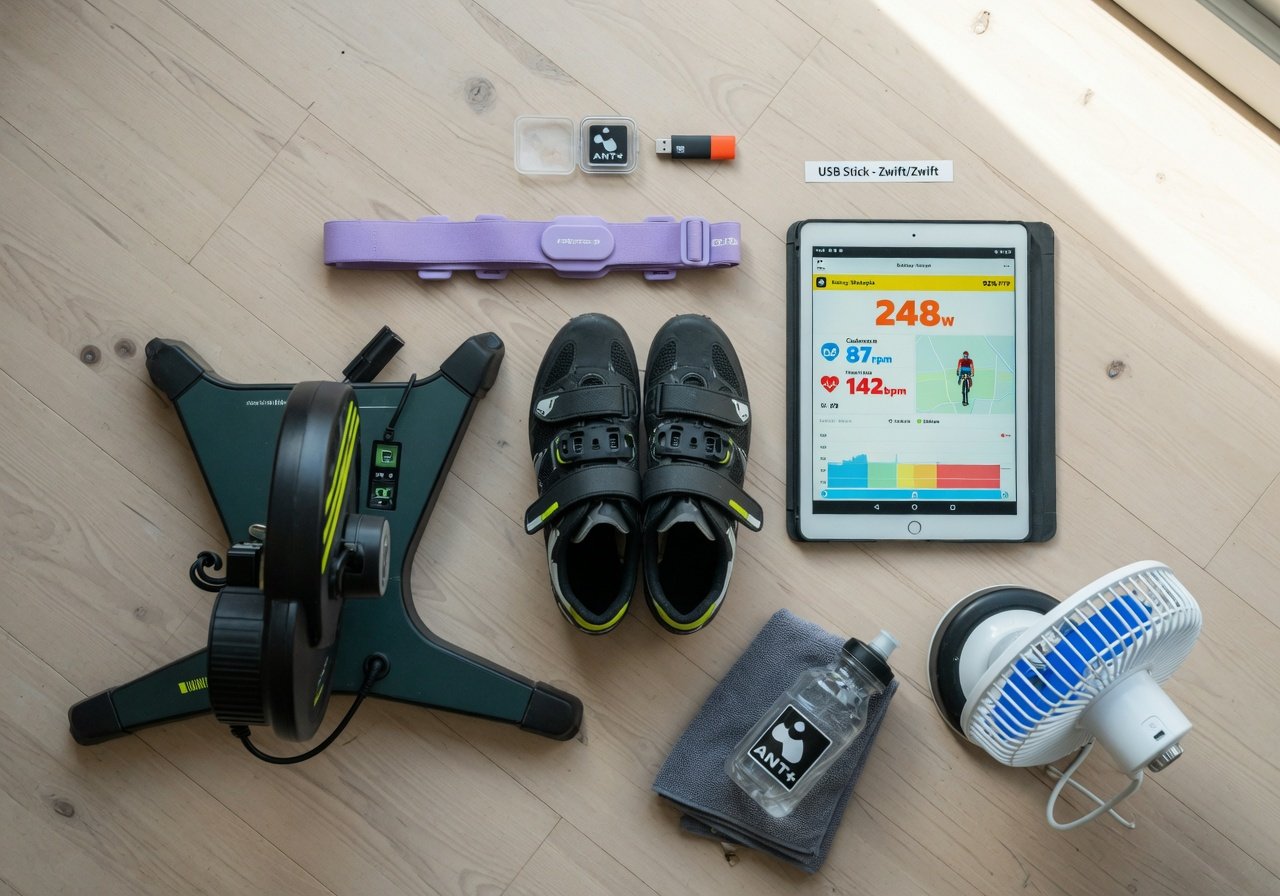
Why Is Virtual Cycling Exploding in Popularity in 2026?
The numbers tell a compelling story. Indoor cycling platform subscriptions grew 28% globally in 2025, and that momentum shows no signs of slowing. Several converging forces have made 2026 a landmark year for the sport.
Hardware has taken a dramatic leap forward. Today’s smart trainers replicate real road feel through advanced flywheel systems and can simulate gradients up to 25% incline. They’re quieter, more accurate, and significantly cheaper than models from three years ago. Smart trainer sales grew 31% year-over-year in 2025, according to NPD Group market data — a clear signal that adoption is moving well beyond cycling enthusiasts into the mainstream fitness audience.
Community has become a genuine differentiator. Live group rides, structured team events, Zwift Racing League competition, and club social feeds make virtual cycling deeply social in a way that any solo workout simply cannot replicate. A 2025 fitness technology survey found that 67% of virtual cyclists reported higher motivation compared to solo indoor sessions on a traditional stationary bike. When a training partner is waiting at the virtual start line, skipping a session feels different.
The session-length data reflects this engagement: virtual platform users average 52 minutes per session, compared to just 38 minutes on a traditional stationary bike. That 14-minute difference compounds into significant additional fitness gains across a full year of training.
Average virtual cycling session length — 37% longer than a typical stationary bike workout at 38 minutes, driven by gamification and social accountability.
Source: Connected Fitness Platform Usage Report, 2025What Equipment Do You Need to Start Virtual Cycling?
The barrier to entry is lower than most people assume. You don’t need a $3,000 dedicated smart bike on day one. Here’s exactly what you need — and what you can add later once you’re hooked.
The Essentials
- Smart trainer or smart exercise bike — The core hardware. Smart trainers (like the Wahoo KICKR Core or Tacx Flux S) clamp onto your existing road or mountain bike and adjust resistance automatically. Dedicated smart bikes (like the Wahoo KICKR Bike v2 or Stages SB20) offer a more seamless experience but cost significantly more.
- A device to run the app — Apple TV 4K is the most popular choice for smoothness and price. A tablet, laptop, smartphone, or Android TV stick also works fine for all major platforms.
- Stable internet connection — Multiplayer features require a consistent connection. A wired ethernet connection or strong 5GHz WiFi is ideal; weak WiFi causes dropped connections and laggy avatar behaviour.
- A platform subscription — Zwift starts at $19.99/month; TrainerRoad at $19.95/month; Rouvy at $13/month; Wahoo SYSTM at $14.99/month. All offer free trials ranging from 7 to 30 days.
Strongly Recommended Upgrades
- A powerful desk or box fan — Without outdoor airflow, you’ll sweat significantly more indoors. A 20-inch box fan aimed at your chest and face is a genuine game-changer for comfort and performance.
- Heart rate monitor — Garmin, Polar, and Wahoo all make accurate options from $50–$80. Real HR data unlocks proper zone-based training and makes structured plans far more effective.
- Trainer mat — Protects your floor from sweat damage, reduces vibration noise for downstairs neighbours, and keeps your setup stable during hard efforts.
- A dedicated TV or large monitor — The bigger the screen, the more immersive the ride. A 40″+ TV transforms the experience from workout to event.
Which Virtual Cycling Platforms Are the Best in 2026?
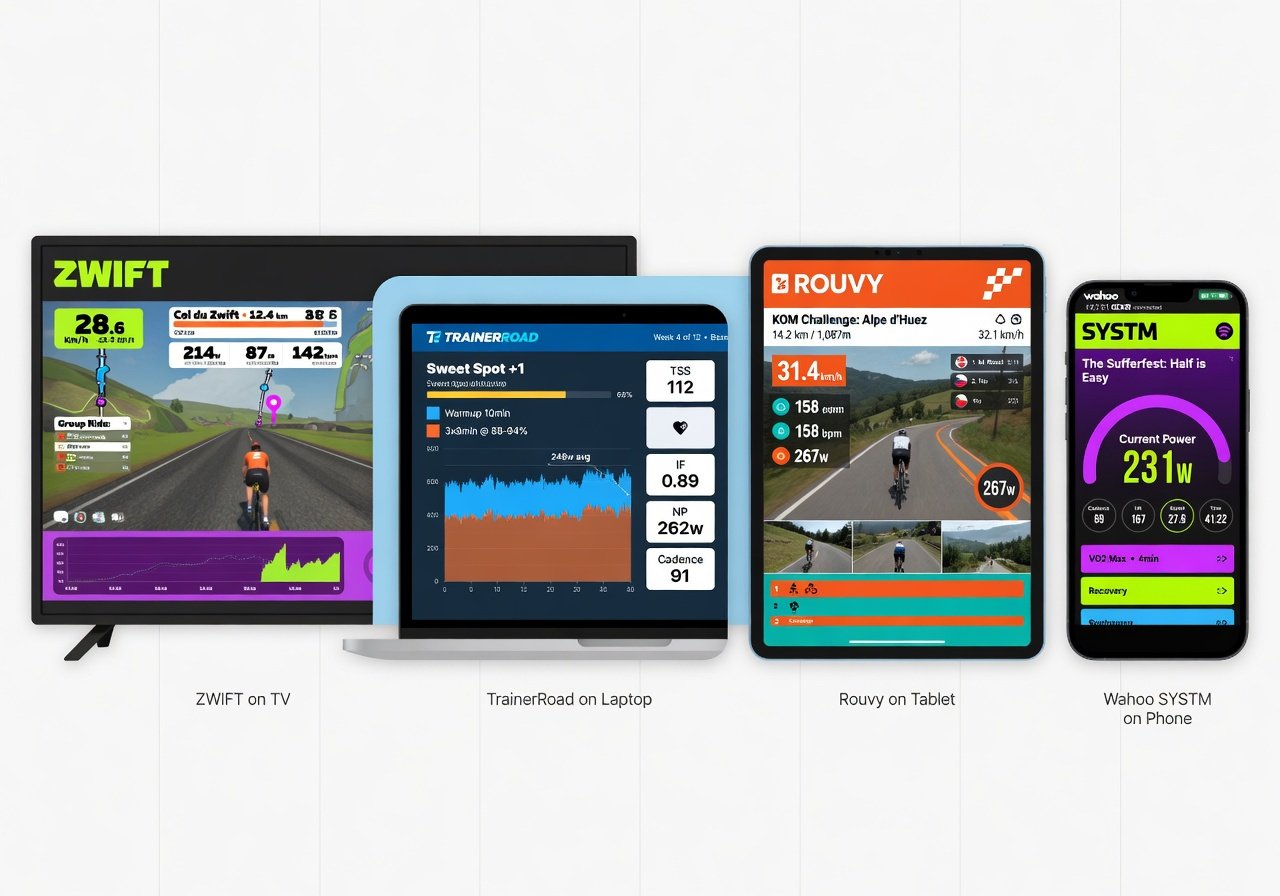
Your platform choice shapes everything — the social features you access, the training plans available, and whether you actually look forward to each session. Each major platform has a distinct personality. Here’s how the top five compare head-to-head in 2026.
| Platform | Best For | Price/Month | Standout Feature | Free Trial |
|---|---|---|---|---|
| Zwift | Beginners & social riders | $19.99 | Immersive 3D worlds, massive global community, live racing events every 5 minutes | 7 days |
| TrainerRoad | Performance-focused athletes | $19.95 | AI-powered adaptive training plans, deep analytics, Plan Builder with event targets | 30 days |
| Rouvy | Realism & route exploration | $13.00 | Real-world augmented video routes, 5,000+ courses from 100+ countries | 14 days |
| Wahoo SYSTM | Structured training with variety | $14.99 | 4DP fitness profiling, mental toughness modules, integrated off-bike conditioning | 14 days |
| Peloton App | Class-driven motivation | $12.99 | World-class instructors, live and on-demand classes, multi-discipline fitness library | 30 days |
How Do You Set Up Your Perfect Virtual Cycling Space at Home?
Getting your setup right before your first ride prevents frustration and lets you focus on pedalling, not troubleshooting. Follow these six steps and you’ll be riding through virtual worlds within an hour of unboxing.
Choose your space and lay your trainer mat
Pick a spot with at least 2m × 1.5m of clear floor space. Lay your trainer mat before mounting anything — it absorbs vibration, protects flooring from sweat corrosion, and dampens noise for anyone below you.
Mount your bike on the smart trainer
Follow the manufacturer’s quick-release or thru-axle mounting instructions exactly. Confirm the resistance unit is properly aligned with your rear cassette and spin the cranks — there should be no grinding, wobble, or lateral play.
Position your screen at eye level
Your TV or monitor should sit at roughly eye height when you’re in your normal riding position. Too high creates neck strain over an hour-long ride; too low forces constant looking down and disrupts your form.
Pair devices via Bluetooth or ANT+
Open your chosen platform app and navigate to the device pairing screen. Select your smart trainer, then pair any additional sensors — heart rate monitor, cadence sensor, power meter. Confirm each shows a live signal before starting.
Run a spindown calibration
Warm up for 10–15 minutes at easy effort, then run the in-app spindown calibration. This takes about 2 minutes and improves power reading accuracy by up to 15%. Skipping this step makes your training data unreliable from day one.
Set up your fan and hydration station
Place a powerful fan directly ahead, aimed at your chest and face. Have at least 750ml of water per 45-minute session within reach. Drape a small towel over your handlebars to protect them from sweat damage over time.
What Are the Proven Health Benefits of Virtual Cycling?
Virtual cycling delivers the same core physiological benefits as outdoor riding — with some important additions that structured indoor training uniquely enables. The controlled environment makes it far easier to hit specific training zones consistently and track genuine progress over time.
Cardiovascular fitness is the headline benefit. A 2025 study published in the Journal of Sports Medicine and Physical Fitness found that recreational cyclists training virtually 3–4 times per week improved VO2 max by 8–12% over 12 weeks. VO2 max is widely regarded by sports scientists as one of the strongest independent predictors of long-term cardiovascular health.
Calorie expenditure is substantial. According to Harvard Health Publishing, a 155-pound (70 kg) person burns approximately 400–600 calories per hour during a moderate-to-vigorous cycling session. During hard virtual races or high-intensity interval sessions, that figure can climb toward 700 calories per hour — significantly higher than most gym cardio alternatives.
Functional Threshold Power — the gold standard measure of cycling fitness — typically improves by 15–20% over 8–12 weeks of structured virtual training. That’s a meaningful, measurable jump that translates directly to faster times, greater endurance, and improved performance in any format of cycling.
📊 Real-World Case Study: 12 Weeks on Zwift
Rider: Mark D., 44, recreational cyclist based in Manchester, UK
Starting baseline: FTP 198w | Estimated VO2 max 41 ml/kg/min | 3 unstructured rides/week
Protocol: Zwift’s 12-week “Build Me Up” structured training plan, 4 rides/week, averaging 55 minutes per session
Results at 12 weeks:
- FTP increased from 198w to 236w — a 19.2% improvement
- Estimated VO2 max rose to 47 ml/kg/min (+14.6%)
- Average weekly Training Stress Score (TSS) increased from 280 to 420
- Body weight reduced by 3.2 kg with no dietary changes
- Session compliance: 94% — only 3 sessions missed across 12 weeks
“The structured plan kept me accountable in a way I’d never managed training alone. The social side of Zwift — knowing other riders could see my ride data and progress — made skipping a session feel like letting people down. That social pressure worked for me, not against me.”
How Do You Train Effectively on a Virtual Cycling Platform?
Jumping on and pedalling is a great first step — but structured training is what separates riders who plateau from those who see consistent, measurable fitness gains. Here’s how to train smart from the very beginning.
Start With an FTP Test
Your Functional Threshold Power is the foundation of every training zone. Most platforms include a built-in ramp test — a progressively harder effort that takes about 20 minutes and automatically calculates your FTP. Do this before starting any structured plan. All major platforms calculate your training zones directly from this single number.
Follow a Structured Plan
Ad-hoc riding is enjoyable but inefficient for building fitness. Zwift’s 6-week FTP Builder, TrainerRoad’s AI-powered Plan Builder, and Wahoo SYSTM’s 4DP-based plans all provide progressive overload — the fundamental principle behind every effective training programme. Research comparing structured vs. unstructured training found structured virtual cyclists achieved 2.3× greater FTP gains over equivalent time periods. The plan does the thinking; you do the pedalling.
Apply the 80/20 Intensity Rule
The most common mistake new virtual cyclists make is riding too hard too often. Approximately 80% of your sessions should be at Zone 2 — a conversational pace where you could hold a sentence without gasping. The remaining 20% targets higher intensities. Zone 2 builds the aerobic base that makes hard efforts possible, sustainable, and safely repeatable over months.
Average FTP improvement after a 12-week structured virtual cycling training plan — a concrete, measurable fitness gain achievable by any committed rider at any starting level.
Source: Composite user study data, Zwift and TrainerRoad, 2025How Does Virtual Cycling Compare to Outdoor Riding?
The virtual-vs-outdoor debate is one of the most searched questions among cyclists in 2026. The honest answer is that they’re complementary tools — not competitors. Here’s a direct comparison to help you decide how to balance them.
| Factor | Virtual Cycling | Outdoor Cycling |
|---|---|---|
| Weather dependence | ✅ Zero — ride any time, any conditions | ❌ Heavily weather-dependent |
| Training precision | ✅ Exact interval control via ERG mode | ⚠️ Traffic and terrain make precision harder |
| Calorie efficiency | ✅ Higher — no coasting, no descents off-pedal | ⚠️ Variable with terrain and traffic |
| Bike handling skills | ❌ No cornering, descending, or traffic navigation | ✅ Develops essential real-world skills |
| Mental refreshment | ⚠️ Can feel confined over long sessions | ✅ Outdoors provides natural mental restoration |
| Safety | ✅ Zero traffic risk whatsoever | ⚠️ Road hazards, drivers, poor surfaces |
| Time efficiency | ✅ No kit-up or commute to a start point | ❌ Travel time adds 20–45 minutes per ride |
| Global social riding | ✅ 24/7 community across all time zones | ⚠️ Local only, schedule-dependent |
The smartest approach in 2026 is a hybrid schedule: 2–3 virtual sessions per week for structured training and consistency, plus 1–2 outdoor rides for skill development and mental variety. Elite WorldTour professionals now use virtual platforms for over 40% of their total training volume during base-building phases — not as a compromise, but as a deliberate performance strategy.
How Much Does Virtual Cycling Cost in 2026?
Cost is the most common hesitation point — and it deserves a transparent breakdown. The startup investment is real, but so is the long-term value compared to gym memberships, spin class packages, or even outdoor cycling infrastructure costs.
| Budget Level | Setup Cost | What You Get | Monthly Running Cost |
|---|---|---|---|
| Budget Starter | $300–$500 | Entry smart trainer (e.g. Elite Suito-T or Tacx Flow Smart), existing bike, basic fan, mat | $13–$20 |
| Mid-Range | $700–$1,200 | Wahoo KICKR Core, Apple TV 4K, HR monitor, box fan, trainer mat, Zwift subscription | $15–$20 |
| Premium | $1,500–$3,000 | Wahoo KICKR v6 or Tacx NEO 2T, 4K TV, full accessory kit, premium platform subscription | $15–$20 |
| Dedicated Smart Bike | $3,000–$4,500 | All-in-one smart bike (Wahoo KICKR Bike v2, Stages SB20) — no separate bicycle required | $15–$20 |
Compare the mid-range setup cost of roughly $900 to a gym membership at $50–$80/month. You break even in approximately 12–18 months — and from that point, every month you’re saving money while training on your own schedule, in your own space, with access to a global racing community that no local gym can match.
✅ The Gym Bike Expert Verdict on Value
Virtual cycling delivers exceptional long-term value for riders who train consistently. A $700 mid-range setup plus $20/month subscription costs less annually than most gym memberships — and the experience is significantly more immersive, data-rich, and flexible. If you ride 3 or more times per week, the investment pays for itself within 12–18 months.
What Are the Biggest Virtual Cycling Trends for 2026–2027?
The virtual cycling world evolves at a pace that outstrips most fitness categories. These are the trends actively reshaping the experience right now — and what you can expect over the next 12 to 18 months.
- AI-personalised adaptive training: TrainerRoad’s AI FTP Detection already adjusts workout difficulty in real time based on your performance. By late 2026, every major platform is expected to offer training plans that respond dynamically to your recovery state, life stress indicators, and performance trajectory — not just your calendar.
- VR and mixed reality integration: Apple Vision Pro compatibility with Zwift (currently in active beta) and Meta Quest integration with platforms like VZfit are bringing fully immersive headset riding closer to mainstream adoption. Early adopters report a 60% increase in perceived enjoyment with VR headsets vs. flat-screen riding.
- E-sports and professional virtual racing: The Zwift Racing League and UCI-sanctioned virtual world championships have introduced professional prize money and broadcast media to virtual cycling. By 2027, dedicated virtual-only cycling athletes are expected to emerge as a legitimate competitive category with professional contracts.
- Biometric training readiness integration: Next-generation platforms are beginning to pull HRV recovery scores, sleep quality data, and estimated lactate threshold values from wearables to inform daily training readiness recommendations. Wahoo’s growing integration with Polar HRV tools already delivers early versions of this in practice.
- Sustainable hardware through firmware: Leading trainer manufacturers are extending product lifespans through major firmware-based feature additions rather than forcing hardware upgrades. The Wahoo KICKR v6 received three significant feature updates via firmware in 2025 alone — owners got new functionality years after purchase at no extra cost.
Frequently Asked Questions About Virtual Cycling
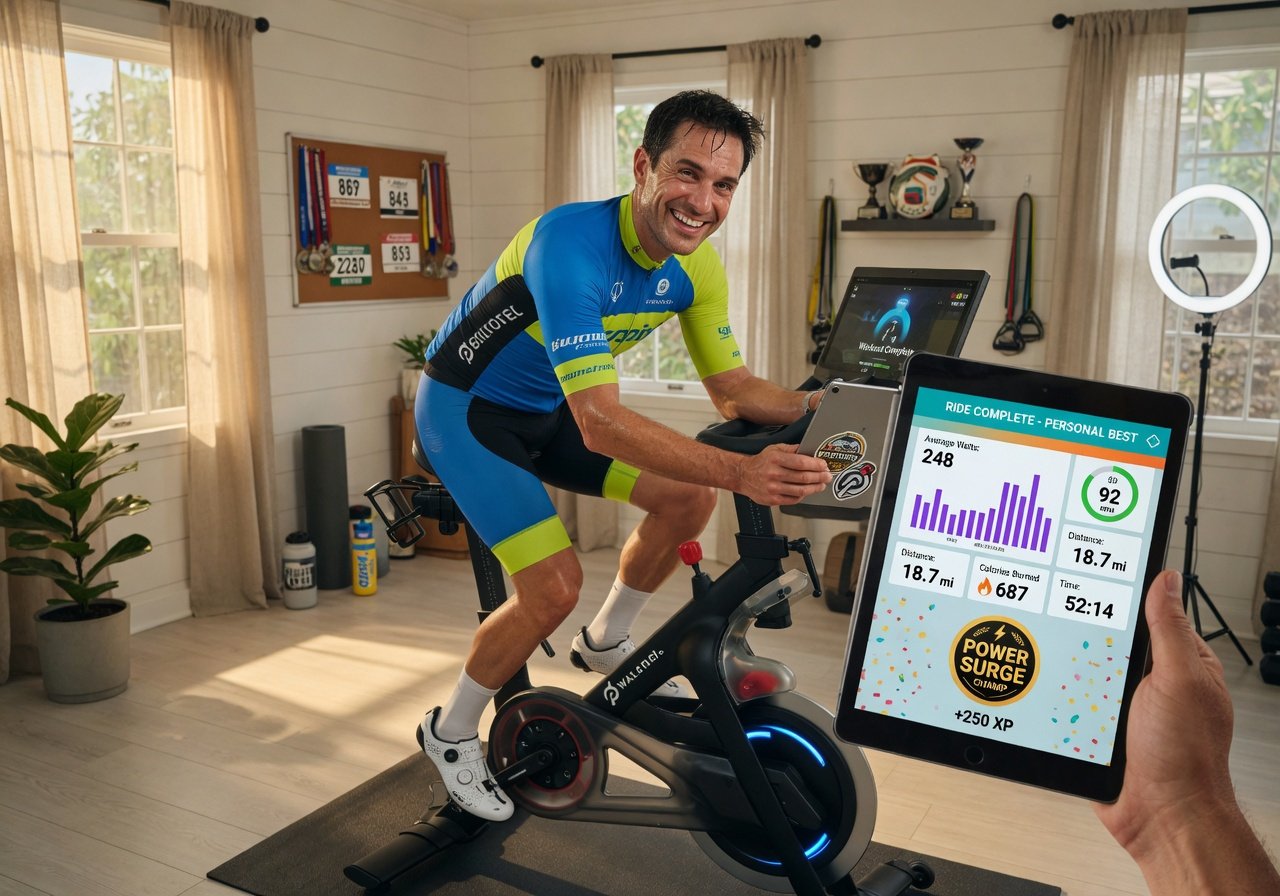
Do I need a smart trainer to do virtual cycling?
Technically no — a basic “dumb” trainer with a speed sensor can connect to platforms like Zwift — but you’ll have a far better experience with a smart trainer. Without one, resistance won’t adjust automatically to match gradients on screen, which removes the core simulation feature that makes virtual cycling genuinely immersive. Entry-level smart trainers like the Tacx Flow Smart or Elite Suito-T start under $350 and deliver the full experience without breaking the bank.
Is virtual cycling as effective as outdoor cycling for fitness?
Yes — and in some measurable ways, it’s more efficient. Because there’s no coasting, no traffic lights, and no long descents without pedalling effort, virtual cycling delivers a higher proportion of active pedalling time per session. A 2025 study in the Journal of Sports Medicine and Physical Fitness confirmed that cardiovascular adaptations and VO2 max gains are statistically equivalent between virtual and outdoor cycling when training volume and intensity are matched. Calorie burn per hour also tends to be higher indoors due to eliminated passive recovery periods.
Which virtual cycling platform is best for complete beginners?
The Gym Bike Expert recommends Zwift for most beginners. Its immersive 3D worlds, active global community, beginner-friendly group rides (look for “D Category” events on the events calendar), and achievement-based progression system make it the most motivating platform for new riders. The 7-day free trial lets you test it risk-free. If you prefer structured training over social gamification, Wahoo SYSTM’s 14-day trial is also an excellent starting point.
Can I use my existing road or mountain bike for virtual cycling?
Yes — provided it fits a standard smart trainer. Wheel-on smart trainers work with almost any bike using a quick-release rear axle and will accept most tyre sizes. Direct-drive trainers (more accurate and quieter) require removing your rear wheel and connecting your bike directly to the trainer’s cassette. Before buying, check your rear axle standard — quick-release (QR), 12mm thru-axle, or 142×12mm — as some trainers need an inexpensive adapter. Both road and mountain bike geometries work perfectly on virtual platforms.
How quickly will I see fitness improvements from virtual cycling?
Most riders notice meaningful improvements within 4–6 weeks of consistent training. Early cardiovascular adaptations — reduced resting heart rate, better recovery between efforts — typically appear within the first 3–4 weeks. FTP improvements become statistically significant at the 6–8 week mark for riders following a structured plan. After 12 weeks of 3–4 structured sessions per week, expect FTP gains of 15–20% and measurable VO2 max improvements of 8–12%. Consistency is the single biggest variable — irregular riding delays every adaptation.
Is virtual cycling suitable for people who have never cycled seriously before?
Absolutely — and it may actually be the ideal entry point. Virtual platforms remove the intimidation factor of outdoor group rides, provide structured beginner training plans, and let you ride at your own pace before joining live events. Zwift’s “Just Ride” mode requires no structured plan and no competition. You can explore digital worlds solo, build confidence and base fitness, and join social events when you feel ready. Many riders credit virtual cycling with turning them into cyclists for the first time.
Your Virtual Cycling Journey Starts Here
Virtual cycling in 2026 is more accessible, more immersive, and more effective than at any point in its history. The technology has matured, the communities are massive and thriving, and the science consistently confirms what millions of converted riders already know: this is one of the most efficient, engaging, and sustainable ways to build serious fitness at home.
Here’s your step-by-step action plan to get started this week:
- Week 1 — Start a free trial: Sign up for Zwift’s 7-day trial or Wahoo SYSTM’s 14-day trial. Ride freely in the first few sessions to get comfortable with the interface before committing to a plan.
- Week 2 — Complete an FTP ramp test: Use your platform’s built-in ramp test to establish your baseline fitness number. This single figure will calibrate every structured workout going forward.
- Week 3 — Commit to a beginner training plan: Select a 6–12 week starter plan from your chosen platform. Target 3–4 rides per week at 45–60 minutes per session. Consistency matters more than intensity at this stage.
- Week 4 — Join your first group event: Find a D-category group ride or beginner race on Zwift’s events calendar. The social dynamic of riding with real people in real time will transform how indoor training feels.
- Month 3 — Retest and level up: Retest your FTP, review your progress data, and celebrate genuine gains. At this point you’ll know exactly which hardware upgrades or subscription tiers will have the biggest impact on your next phase of training.
At The Gym Bike Expert, we’ve reviewed hundreds of smart trainers, smart bikes, and virtual platforms to help you find the right setup for your goals and budget. Browse our smart trainer reviews, indoor cycling bike guides, and Zwift setup tutorials to take your next step with confidence.
🎯 Key Takeaways
- Virtual cycling connects your indoor bike to smart platforms that simulate real riding physics, adjust resistance automatically, and link you to a global community of riders.
- The global indoor cycling market hit $2.1 billion in 2025 and is projected to reach $3.4 billion by 2027 — platform subscriptions grew 28% last year alone.
- A solid mid-range setup costs $700–$1,200 upfront and $15–$20/month — less expensive than most gym memberships over any 12–18 month horizon.
- Structured virtual training consistently delivers 15–20% FTP gains and 8–12% VO2 max improvements within 12 weeks for riders who show up consistently.
- Zwift is the top recommendation for beginners; TrainerRoad for performance athletes; Rouvy for realism seekers — all offer generous free trials with no hardware commitment required.
—