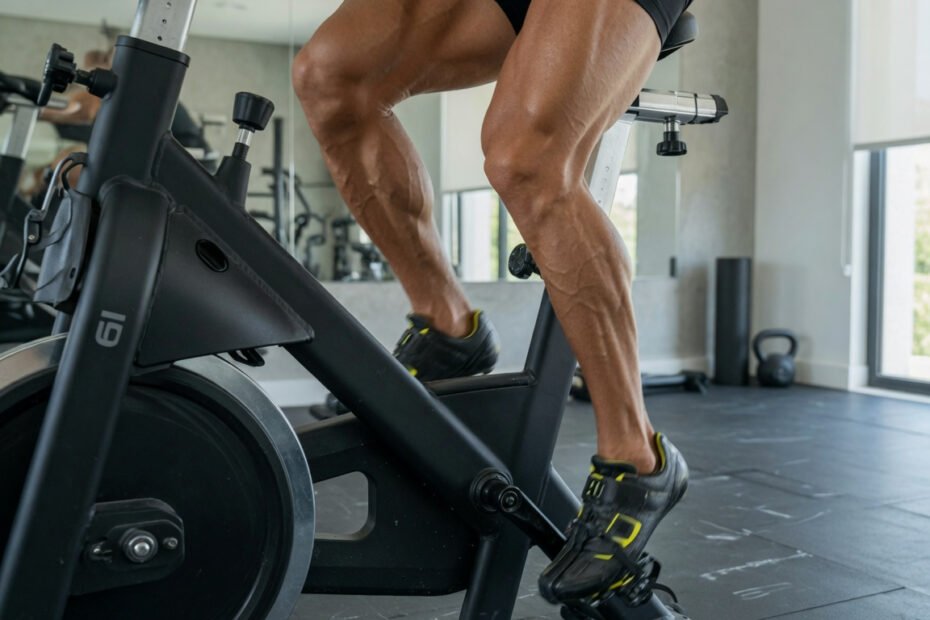
Yes, a stationary bike can build muscle — especially in your lower body. The catch? You have to push the resistance high enough to actually challenge your muscles. Here’s what it takes.
Some of the links in this article may be affiliate links. If you make a purchase through these links, we may earn a small commission at no extra cost to you. Thank you.
- Stationary bikes primarily build and tone the quadriceps, hamstrings, glutes, and calves
- Higher resistance is the single biggest factor in triggering muscle growth on a bike
- HIIT-style intervals recruit fast-twitch muscle fibers and produce faster gains than steady-state cardio alone
- Most riders notice meaningful leg definition within 4–8 weeks of consistent high-resistance training
Which Muscles Does a Stationary Bike Actually Work?
A stationary bike isn’t a full-body machine, but it hits the lower body hard. Every pedal stroke loads multiple major muscle groups at once — which is why dedicated cyclists tend to have well-developed legs even without touching a weight rack.

Here’s exactly what’s working during a typical ride:
- Quadriceps — The large muscles at the front of your thighs. They power the downstroke of each pedal revolution, accounting for roughly 40% of total force production during cycling.
- Hamstrings — The muscles at the back of your thighs fire on the upstroke, especially when you use toe cages or clip-in pedals that let you pull as well as push.
- Glutes — Your gluteus maximus and medius engage hard when resistance is high. Seated climbing at heavy resistance is one of the most effective glute exercises available indoors.
- Calves — The gastrocnemius and soleus stabilize your ankle through each stroke, building calf endurance and shape over time.
- Hip flexors — These smaller muscles control the top of each pedal stroke and strengthen significantly with consistent training.
- Core — Your abs and lower back work isometrically throughout every ride to keep you stable and upright on the saddle.
Your upper body is mostly a passenger on a stationary bike. To target your arms and shoulders directly alongside your cycling sessions, adding dedicated arm work to your rides fills that gap well.
Can a Stationary Bike Truly Build Muscle — Or Just Tone?
This is the big question, and the answer hinges on one word: resistance.
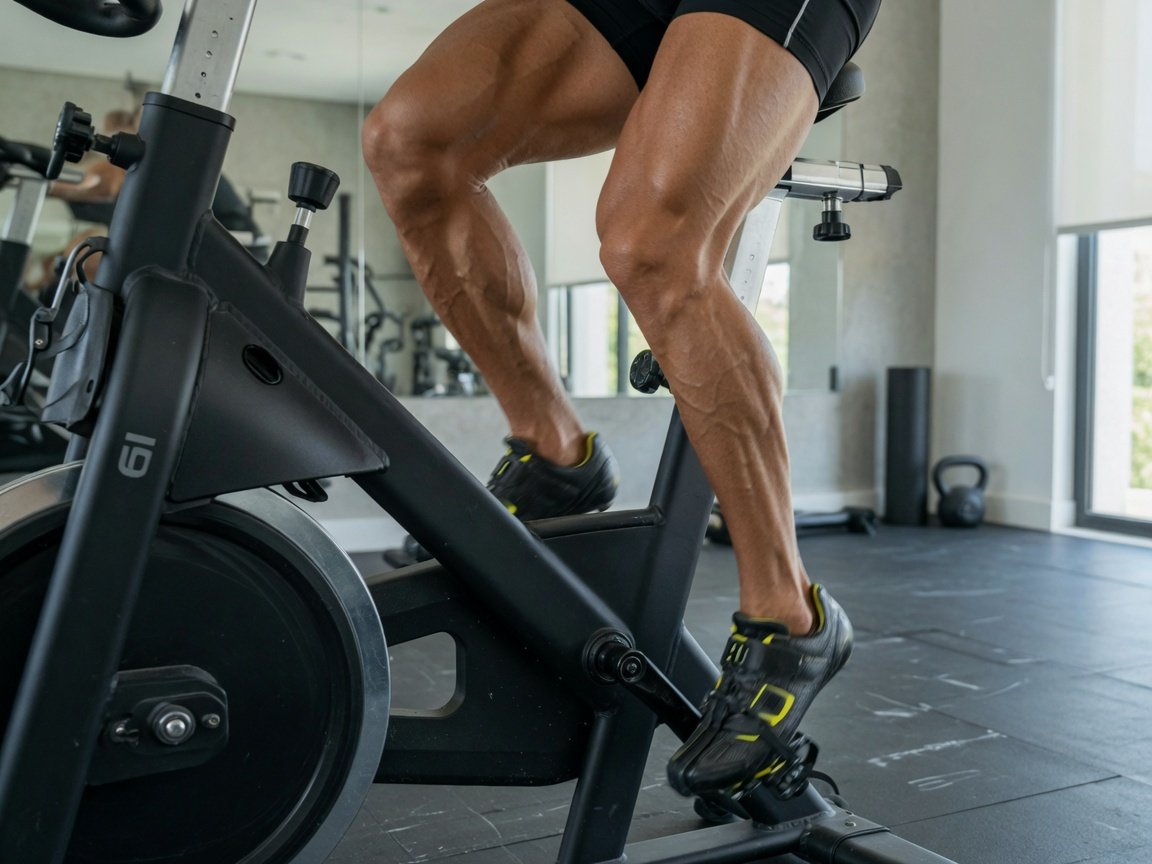
True muscle hypertrophy — actually making your muscles bigger and stronger — requires progressive overload. That means consistently challenging a muscle with more resistance than it’s used to handling. A stationary bike can absolutely deliver that stimulus, but only if you’re willing to crank the dial up. Spinning at a light, easy pace for 45 minutes is good for your cardiovascular system but barely registers for your muscles.
Exercise physiology research consistently shows that training at roughly 70–80% of maximum muscular effort is the threshold needed to stimulate meaningful muscle protein synthesis. A properly calibrated stationary bike hits that threshold easily during high-resistance intervals.
For beginners, gains come fastest. If you haven’t trained your legs regularly, even moderate cycling resistance will spark noticeable muscle development within 4–6 weeks. For experienced gym-goers, a stationary bike is best framed as a muscle-maintenance and definition tool — it won’t replace heavy squats, but it will keep your legs strong, lean, and conditioned.
The bottom line: yes, a stationary bike builds real muscle. It just builds the most muscle when you treat it like a resistance training tool rather than a cardio machine. For a structured plan that does exactly that, this stationary bike workout built specifically for muscle development is a solid starting point.
The Key Factor: Resistance Is Everything
If there’s one thing to take from this entire article, it’s this: resistance is the lever that turns a cardio session into a muscle-building session.
When you increase resistance, your muscles have to generate more force per pedal stroke. That increased force demand is what creates the micro-tears in muscle fibers that, once repaired, leave your muscles bigger and stronger than before. Low resistance doesn’t create that demand — it just keeps your heart rate elevated.
Research in exercise science has found that cycling at high resistance engages up to 40% more muscle fiber than the same duration of pedaling at low resistance. That’s not a marginal difference — it’s the difference between a toning session and a muscle-building session.
The practical test: if you can hold a comfortable conversation while riding, your resistance is too low to build muscle. You should be working hard enough that talking becomes a real effort, especially during your high-resistance intervals. Cadence slows naturally when resistance is high — aim for 60–80 RPM rather than spinning at 100+ RPM.
If you want to dial in exactly how to structure resistance for maximum strength gains, these stationary bike resistance training plans cover the specific settings and protocols that push your muscles hardest.
High Resistance Intervals vs. Steady Cardio — Which Builds More Muscle?
Both approaches have value — but they don’t work equally for muscle building. Here’s how they compare directly:
| Factor | High Resistance Intervals | Steady-State Cardio |
|---|---|---|
| Muscle fiber recruitment | High (fast-twitch + slow-twitch) | Moderate (mostly slow-twitch) |
| Caloric burn per session | High | Moderate |
| Post-workout calorie burn (EPOC) | High — up to 24–48 hours | Low |
| Muscle hypertrophy potential | High | Low to moderate |
| Session time needed | 20–30 minutes | 45–60 minutes |
| Best for | Muscle building + fat loss | Endurance + active recovery |
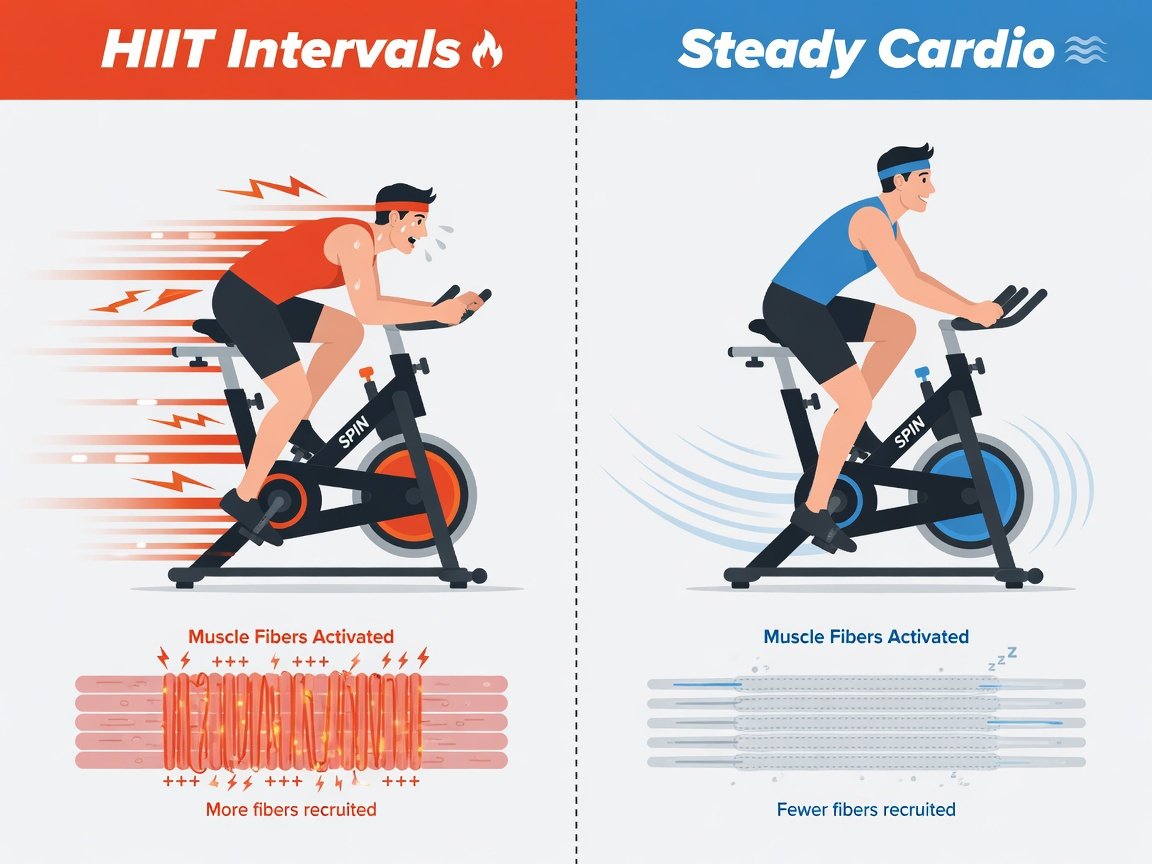
High resistance interval training wins for muscle building — and it’s more time-efficient. Short, intense bouts of effort recruit fast-twitch muscle fibers, which have the greatest capacity for growth. Steady-state cardio at low resistance mostly trains slow-twitch fibers, which are built for endurance rather than size and strength.
That said, steady-state cycling still contributes. It builds muscular endurance, improves blood flow to recovering muscle tissue, and supports active recovery between harder sessions. The ideal weekly plan combines both: 2–3 high-resistance interval sessions and 1–2 moderate-effort steady rides per week.
How HIIT on a Stationary Bike Triggers Muscle Growth
High-Intensity Interval Training on a stationary bike is one of the most effective muscle-building approaches you can do indoors — and sessions stay short. The mechanism is straightforward.
During a sprint interval — say, 20–30 seconds of all-out effort at maximum resistance — your body recruits fast-twitch Type II muscle fibers that you simply can’t reach during low-intensity exercise. These fibers have the highest potential for hypertrophy. You’re essentially performing a rapid-fire leg press with every pedal stroke during those bursts.
Studies comparing HIIT cycling to steady-state cardio consistently find that HIIT participants develop significantly more leg muscle mass over an 8–12 week period, even though their total training time is often 30–40% shorter. HIIT also keeps your metabolism elevated for up to 24–48 hours post-workout through excess post-exercise oxygen consumption (EPOC).
A simple starter HIIT protocol for muscle building:
- Warm up at moderate resistance for 5 minutes
- Sprint at maximum effort and maximum resistance for 20 seconds
- Recover at low resistance for 40 seconds
- Repeat for 8–10 rounds
- Cool down at an easy pace for 5 minutes
Total time: under 25 minutes. Muscle stimulus: substantial. For more interval formats — from beginner-friendly ladders to advanced sprint pyramids — this complete guide to HIIT stationary bike workouts covers the full range.
How to Set Up Your Bike to Maximize Muscle Activation
Bike setup matters more than most riders realize. A poorly adjusted bike doesn’t just cause discomfort — it actively reduces muscle activation by pulling key muscles out of their optimal range of motion on every single pedal stroke.
Here are the four adjustments that have the biggest impact on muscle engagement:
- Seat height: When your foot is at the very bottom of the pedal stroke, your knee should have a slight bend — roughly 5–10 degrees. Too low and your quads never fully extend; too high and your glutes disengage. Getting this right can increase quad and glute activation by up to 25% compared to a poorly set seat height.
- Seat fore/aft position: Slide the seat forward or back so your knee is directly over the pedal axle when the crank arm is at the 3 o’clock position. This keeps your quads in their power zone throughout the full pedal stroke.
- Handlebar height: For maximum muscle building, slightly lower handlebars encourage a more forward lean that engages your glutes more on each downstroke. For comfort-focused riding, keep them level with or slightly above the seat.
- Foot position: The ball of your foot should sit centered over the pedal axle. Pushing through the heel shifts load away from the calves and quads — not ideal for muscle development.
Getting your seat dialed in is the single highest-return setup change you can make. For a clear walkthrough of the process, these three steps to perfecting your stationary bike seat will get you properly positioned in minutes.
How Long Until You See Muscle Results?
Here’s a realistic timeline based on 3–4 sessions per week with adequate resistance and sufficient protein intake:
- Weeks 1–2: Neuromuscular adaptations begin. Your nervous system gets better at recruiting the muscles involved in cycling. No visible changes yet, but your strength and endurance improve noticeably — you’ll be able to sustain higher resistance longer than when you started.
- Weeks 3–4: Muscular endurance increases significantly. Your legs feel more powerful and your capacity to hold heavy resistance grows. Some riders notice early visual changes in leg definition around this point.
- Weeks 5–8: Visible muscle development becomes apparent for most people. Quads fill out, calves develop more shape, glutes become better defined. This is the phase where consistent cyclists typically have their “wow, this is actually working” moment.
- Months 3–6: Substantial lower body strength and muscle development. Research indicates that exercisers who maintain consistent high-resistance cycling for 12+ weeks gain an average of 1.5–2.5 kg of lean leg muscle mass — without any additional weight training.
The most important variable across all of this? Consistency. Three focused sessions per week maintained over months beats seven half-hearted sessions every time, both for results and for sustainability.
The Honest Limits of Stationary Bike Muscle Building
A stationary bike is a genuinely effective muscle-building tool — but it’s worth being clear-eyed about where it excels and where it falls short.
It’s primarily a lower body tool. Your quads, hamstrings, glutes, and calves will develop meaningfully. Your chest, back, and arms won’t. If full-body development is the goal, pair your cycling sessions with some form of upper body resistance work.
It won’t maximize muscle volume. Bodybuilder-level mass requires heavy compound lifts — squats, deadlifts, leg presses — that load the muscle with significantly more weight than any stationary bike can replicate. A bike will make your legs noticeably stronger and better defined, but it won’t produce the same volume as dedicated weight training.
Resistance has a ceiling. Even the best spin bikes have a maximum resistance level. Once your legs adapt to that maximum, further hypertrophy naturally slows. Many advanced cyclists combine bike training with some weighted leg work to keep progressing past that plateau.
Nutrition is non-negotiable. Building muscle anywhere — on a bike or in a gym — requires adequate protein. Most exercise scientists recommend 1.6–2.2 grams of protein per kilogram of body weight daily to support muscle repair and growth. Without hitting that target, training effort doesn’t convert into new muscle effectively regardless of how hard you ride.
If you want to build powerful, well-defined legs with programming that addresses these limits directly, this guide to transforming your lower body with static bike training is the right place to look.
Five Proven Strategies to Build More Muscle on Your Stationary Bike
These five strategies will get you to visible results faster than riding without a plan.
- Apply progressive overload every week. Add one or two resistance levels each week. Your muscles adapt quickly — if you’re still using the same resistance setting you used three weeks ago, you’ve stopped growing. Write down your settings after each session so you can track the progression over time.
- Use seated climbs. Crank the resistance to an 8 or 9 out of 10 and pedal slowly and powerfully at 60–70 RPM. This mimics the stimulus of a leg press and is one of the most effective quad and glute exercises you can perform on a bike. It’s uncomfortable — that’s the point.
- Add sprint intervals. Short, all-out sprints at maximum resistance activate fast-twitch muscle fibers that long, slow rides will never touch. Even 6–8 sprint intervals per session dramatically increase your overall muscle-building stimulus. Getting your resistance dialed in properly for these sprints makes all the difference — this complete guide to perfecting your spin bike’s resistance walks through exactly how to do it.
- Respect recovery. Muscles don’t grow during exercise — they grow during the 24–48 hours afterward while you rest. Allow at least one full rest day between hard sessions and aim for 7–9 hours of sleep each night. This is when adaptation actually happens.
- Hit your protein targets. No training plan compensates for inadequate nutrition. Aim for at least 1.6g of protein per kilogram of bodyweight daily and spread it across 3–5 meals or snacks for optimal muscle protein synthesis throughout the day.

Frequently Asked Questions
Can a stationary bike build muscle in your legs?
Yes — and it does so quite effectively when resistance is high enough. The quads, hamstrings, glutes, and calves are all directly trained with every pedal stroke. At high resistance, the stimulus is similar to performing repetitive leg press movements, which is precisely the kind of load that stimulates muscle hypertrophy. Most regular cyclists notice significant leg definition within 6–8 weeks of consistent high-resistance training.
Is a stationary bike better for fat loss or muscle building?
It’s genuinely effective for both — and you don’t have to choose between them. High-resistance interval training burns significant calories, builds lower body muscle, and keeps your metabolism elevated for hours after the session via the EPOC effect. Muscle building requires high resistance and progressive overload; fat loss requires a calorie deficit through diet and activity. Those two goals work together well on a stationary bike.
How many days a week should I ride to build muscle?
Three to four sessions per week is the sweet spot for most people. This gives your muscles enough training frequency to adapt and grow while allowing adequate recovery time between sessions. If you’re riding every day, ensure at least two of those sessions are lower intensity — active recovery rides rather than hard muscle-building efforts. Overtraining without recovery is one of the fastest ways to stall your progress.
What resistance level builds the most muscle on a stationary bike?
For muscle building, you want to work at a resistance level where you can maintain clean pedal form but it feels genuinely challenging — roughly a 7–9 out of 10 on perceived effort. At this intensity, your cadence will naturally drop to 60–80 RPM during high-resistance efforts. If you can pedal fast and comfortably at your resistance setting, it’s too light to drive meaningful muscle growth.
Will a stationary bike make my legs too big?
This concern is common — and for most people, largely unfounded. Stationary bike training builds lean, functional muscle mass rather than bulky size. The type of training a bike produces develops muscle density and definition rather than raw volume. Unless you’re eating a substantial calorie surplus on top of your training, cycling is far more likely to slim and define your legs than to bulk them up. Women in particular tend to find that consistent cycling creates longer, leaner-looking legs rather than larger ones.
Can you build glutes on a stationary bike?
Yes, and the stationary bike is genuinely underrated as a glute-building tool. Seated climbs at heavy resistance — pushing down powerfully through high resistance at a slow, deliberate cadence — are among the most effective glute exercises you can perform indoors without weights. Standing climbs engage the glutes even more where your bike allows it. The critical variable is always resistance: at low resistance, your glutes barely contribute; at high resistance, they’re working hard with every single revolution.
How does a stationary bike compare to squats for building leg muscle?
Squats generally produce greater raw muscle volume because they allow you to load the legs with significantly more weight than a bike can replicate. However, a stationary bike has real advantages: it’s joint-friendly (much lower impact than barbell squats), accessible to people with knee or back issues, and excellent at building muscular endurance alongside strength. For most recreational exercisers, combining stationary bike training with some weighted lower body work gives the best of both worlds.
The Bottom Line
Can a stationary bike build muscle? Absolutely — but it requires intention. Light, breezy cycling sessions will keep your heart healthy and your mood elevated, but they won’t change the shape of your legs much. Push the resistance, add high-effort intervals, track your progression week over week, and fuel properly with adequate protein — and you’ll see real, measurable muscle development in your quads, hamstrings, glutes, and calves within weeks.
The stationary bike is one of the most joint-friendly, accessible, and time-efficient lower body training tools available. Most people just never push it hard enough to see what it can actually do.
Start this week. Ride three times. Use more resistance than feels comfortable. Give it eight weeks and watch what happens to your legs.